
How Corn Silk, Hericium erinaceus & Ganoderma lucidum Polysaccharides Synergize to Scavenge Free Radicals
June 3, 2026
Natural Lip Color with Antioxidant Power: How Wolfberry & Sea Buckthorn Oil Replace Synthetic Dyes
June 6, 2026Polyphenols, Polysaccharides & Omega-7 Oil — The Complete Bioactive Profile of Sea Buckthorn
INGREDIENT SCIENCE · SEA BUCKTHORN
Sea Buckthorn Bioactive Profile: Six Compound Classes, Dozens of Health Mechanisms
From the “King of Vitamin C” (600–1,200 mg/100 g) to synergistic polyphenols, polysaccharides, and cold-pressed oil — a research-backed deep dive into Hippophae rhamnoides L. and how it performs across supplements, cosmetics, and functional food formulations.
Based on: Liang T. et al. (2026). Food and Fermentation Industries. DOI: 10.13995/j.cnki.11-1802/ts.046034 | Published by TongyuBio
Why Sea Buckthorn Keeps Outperforming Its Reputation
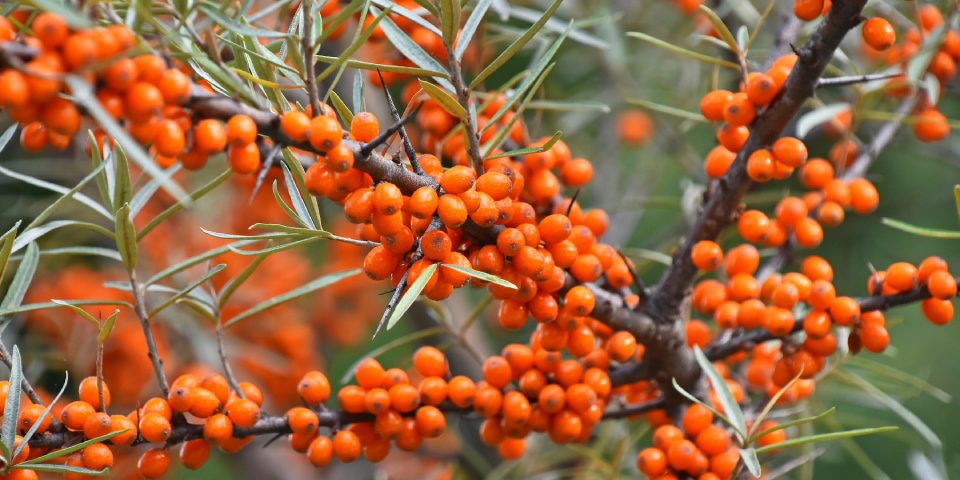
Hippophae rhamnoides L. — commonly known as sea buckthorn, sandthorn, or sallow thorn — is a deciduous shrub that thrives in arid, cold, and nutrient-poor soils across Central Asia, Northern China, and Europe. Its pharmaceutical use dates back to at least the 8th century CE, when the Tibetan medical classic Yue Wang Yao Zhen described it as a treatment for pulmonary diseases. China’s Pharmacopoeia first codified it in 1977; four years later, it was officially classified as a “medicinal and edible homology” plant by the Ministry of Health.
Modern food science has done the legwork to explain why this shrub earns such enduring attention. A 2026 systematic review by Liang Tisong et al. (Food and Fermentation Industries) consolidates data from more than 60 peer-reviewed studies to profile six bioactive compound classes — each with distinct mechanisms and formulation opportunities. What follows is a distillation of that science, oriented toward ingredient buyers and product developers.
Sea buckthorn is documented across cardiovascular, dermatological, hepatoprotective, immunological, and oncological research contexts — a breadth that few botanical ingredients can match. The challenge for formulators is not finding evidence; it is choosing which mechanism to lead with.
The Six Bioactive Compound Classes
Sea buckthorn berries and leaves contain a dense, overlapping matrix of active constituents. The six primary classes are summarized below, with select mechanism data drawn from peer-reviewed in vitro, animal, and clinical studies.
1. Polyphenols (9.86–18.79 mg/g)
Polyphenols are the most extensively researched fraction of sea buckthorn, representing over 40 identified compounds across three sub-classes: flavonoids, phenolic acids, and tannins. Content varies with variety, harvest region, extraction site (berry vs. leaf), altitude, and soil composition.
| Activity | Model / Subject | Key Finding | Ref. |
|---|---|---|---|
| Anti-aging / neuroprotection | C. elegans (nematode) | Total flavonoids (50 µg/mL) inhibited AChE by 75.85%, MAO by 51.22%; extended wild-type lifespan | [15] |
| Anti-tumor | HCT-116 colon cancer cells | Polyphenol extract significantly inhibited proliferation and induced apoptosis in a dose-dependent manner | [12] |
| Radioprotection | Mouse bone marrow (in vivo) | Freeze-dried extract RH-3 (25–35 mg/kg) suppressed radiation-induced micronuclei; inhibited Fenton reaction and DNA strand breaks | [18] |
| Antibacterial | E. coli, Salmonella, Bacillus subtilis | Polyphenol ethanol extract disrupted bacterial cell membrane integrity and suppressed growth | [19] |
| Anti-obesity / lipid regulation | Diet-induced obese mice | Inhibited fatty acid synthase and related enzymes; antioxidant and lipid metabolism modulation | [34] |
| Gut microbiota modulation | Allergic mouse model | Adjusted glycerophospholipid and histidine metabolism; modulated microbiota and attenuated allergic response | [37] |
Extraction note: Current industrial polyphenol production relies on ultrasound- or microwave-assisted physical disruption methods. Most commercial extracts are crude fractions. The presence of co-extracted sugars, lipids, and proteins reduces polyphenol purity, which limits bioavailability and creates a clear formulation-grade differentiation opportunity.
2. Polysaccharides
Sea buckthorn polysaccharides (SBPs) are isolated primarily from berries and leaves and have been characterized into neutral (SBP-I) and acidic (SBP-II, SBP-III) fractions. Key monosaccharide units include glucose (84.65%), galactose (62.68%), and xylose (40.8%), with compositional variation between fractions.
| Activity | Model | Mechanism | Ref. |
|---|---|---|---|
| Immunomodulation | Cyclophosphamide-immunosuppressed mice | HRWP-A fraction restored immune function via TLR4/NF-κB pathway; activated macrophage phagocytosis | [22] |
| Hepatoprotection | LPS/D-GalN-induced acute liver failure (mice) | Suppressed TLR4, ERK, p-JNK, MAPK, and NF-κB expression; reduced ALT/AST elevation | [23] |
| Anti-fatigue | Weight-bearing swimming mice | Significantly extended swimming time (P<0.05); reduced blood lactate, increased liver glycogen | [24] |
| Gut microbiota regulation | Antibiotic-disrupted mice (cefixime model) | Promoted short-chain fatty acid (SCFA) production; restored microbiota balance | [25] |
| Glucose regulation | In vitro enzymatic model | At 0.625 g/L, inhibited α-glucosidase activity by 92.52% | [26] |
| Anti-colitis | Colitis mouse model | Improved colonic barrier integrity; increased beneficial bacteria; raised SCFA production | [41] |
3. Sea Buckthorn Oil (Berry Oil, Seed Oil, Whole-Fruit Oil)
Sea buckthorn oil exists in three commercial forms: berry pulp oil, seed oil, and whole-fruit oil. Berry pulp oil is particularly rich in palmitoleic acid (Omega-7, 28–35%), oleic acid, linoleic acid, tocopherols, phytosterols, carotenoids, and flavonoids — a fatty acid profile almost unique in the plant kingdom.
| Oil Type / Activity | Model | Finding | Ref. |
|---|---|---|---|
| Seed oil — antioxidant | CCl₄-induced oxidative stress (in vitro) | DPPH scavenging, ferrous ion chelation, and lipid peroxidation inhibition were all concentration-dependent | [28] |
| Berry oil — oral mucosa | Clinical (recurrent aphthous ulcer patients) | Significantly shortened healing time and pain duration for severe recurrent oral ulcers | [29] |
| Berry oil — skin inflammation | Atopic dermatitis mice | Reduced local cutaneous inflammation; inhibited IgE-mediated hypersensitivity (Th1/Th2 balance) | [30] |
| Oil — hepatoprotection | Alcohol-induced liver injury (rats) | Elevated reduced glutathione (GSH) levels; protected hepatocytes via antioxidant and lipid metabolism modulation | [31] |
| Oil — antifungal | Aspergillus niger | Disrupted mitochondrial membrane permeability and structure; inhibited fungal growth | [32] |
SC-CO₂ Extraction Advantage — Active Compound Retention
Seed Material
Extraction
(≥90% retention)
Concentration
Omega-7 28–35%
Full carotenoid profile
GMP certified
4. Vitamins: Vitamin C, E, A & Carotenoids
Sea buckthorn berries contain 600–1,200 mg of Vitamin C per 100 g — significantly higher than tomato (~20 mg), kiwifruit (~90 mg), or apple (~6 mg), earning the “King of Vitamin C” designation in Chinese botanical medicine. Vitamin E (tocopherols + tocotrienols) content likewise substantially exceeds peanut, sesame, and soybean. Carotenoids contribute strong free-radical quenching activity and anti-tumor and anti-aging properties alongside beta-carotene precursor activity.
5. Minerals: 27 Elements Including Fe, Ca, K, Zn
Sea buckthorn delivers a notable mineral complement: Fe content approximately 4× that of apple; Ca approximately 5× that of citrus fruit. A Yushu (Qinghai) cultivar analysis reported a total mineral content of 748.1 mg/100 g across 9 mineral elements, with K, P, Na, Fe, and Zn predominating. Importantly, heavy metal screening of large-fruited cultivar oils found no detectable Pb, Cd, or Ni, supporting its safety profile for nutraceutical applications.
6. Other Bioactives: Organic Acids, Protein & Serotonin
Seed meal provides a high-quality plant protein. Organic acids (malic, citric, quinic) support digestion, vascular softening, lipid-lowering, and antimicrobial functions. Notably, sea buckthorn contains the neurotransmitter 5-hydroxytryptamine (5-HT / serotonin), to which anti-tumor, anti-infective, and radioprotective activities have been attributed.
Bioactivity at a Glance
Across all six compound classes, peer-reviewed research documents at least eight distinct health mechanisms relevant to the supplement, cosmetic, and functional food categories.
Antioxidant
Free-radical scavenging documented across polyphenols, oil, polysaccharides, Vitamin C/E, and carotenoids. Nrf2/Keap1 pathway activation confirmed in mouse model.
Anti-inflammatory
Berry oil reduced atopic dermatitis lesions; polyphenols inhibited NF-κB and MAPK signaling cascades; clinical evidence in chronic periodontitis management.
Neuroprotection & Anti-aging
Flavonoids inhibited AChE and MAO (75.85% and 51.22%); extended nematode lifespan; polyphenols protect against D-galactose-induced aging in mice.
Cardiovascular / Hepatoprotective
Oil elevated GSH levels and regulated lipid metabolism; polysaccharides suppressed TLR4-NF-κB to reduce LPS-induced acute liver failure markers.
Glucose & Metabolic Regulation
Polysaccharides inhibited α-glucosidase by 92.52% at 0.625 g/L; polyphenols inhibited FASN and reprogramed hepatic lipid homeostasis in high-fat diet models.
Immunomodulation
HRWP-A polysaccharide restored cyclophosphamide-induced immunosuppression via TLR4/MyD88; polyphenol extracts showed adjuvant-like enhancement of macrophage antigen presentation.
Mucosal / Skin Repair
Berry oil showed clinical efficacy in recurrent aphthous ulcers; seed oil modulated UV-induced lipid metabolism changes in human skin cells in vitro.
Gut Microbiota Regulation
Polysaccharides promoted SCFA-producing bacteria and restored antibiotic-disrupted microbiomes; polyphenols modulated glycerophospholipid and histidine metabolism pathways.
China’s Sea Buckthorn Industry: Scale and Structure
Annual processing capacity 80,000–100,000 tonnes; total output value RMB 24–26 billion. Approximately 3,200 enterprises nationwide, including 200+ deep-processing manufacturers. Four major production zones:
North China
Inner Mongolia (9.08M mu), Shanxi (4.5M mu). Focus: refined extraction, sea buckthorn oil, functional foods.
Northwest China
Gansu (2.1M mu), Shaanxi (3M mu). Focus: raw material supply, primary processing, sea buckthorn juice.
Northeast China
Liaoning (1.2M mu), Jilin (750K mu). Focus: large-fruited cultivar processing, snacks, sea buckthorn wine.
Southwest China
Sichuan (6M mu), Yunnan (750K mu). Focus: wild-harvested sea buckthorn, pharmaceutical raw materials, teas.
SC-CO₂ extraction, cold-press technology, and cold-chain logistics have raised active compound retention rates to ~90% vs. traditional solvent methods. 19 sea-buckthorn-based pharmaceuticals are approved for cardiovascular, dermatological, respiratory, reproductive, and digestive indications.
Four Growth Application Categories
The 2026 review identifies four industrial application pathways in order of current market maturity and near-term growth potential:
| Application Category | Primary Bioactives Used | Market Status | Key Opportunity |
|---|---|---|---|
| Dietary Supplements | Sea buckthorn oil, polysaccharides, polyphenol extract | Active market; oral capsules well-documented for skin aging, HDL-C, and antioxidant enzyme activity | Nano-emulsion and microencapsulation to enhance bioavailability; combination with probiotics for gut-health positioning |
| Cosmetics & Personal Care | Berry oil (Omega-7 / carotenoids), seed oil, polyphenol extract | Growing; clinical support for anti-inflammation, skin barrier repair, UV protection | High-purity SC-CO₂ oil for premium skincare; carotenoid-rich fraction for anti-aging serums |
| Beverages & Functional Foods | Whole-berry extract, polysaccharides, Vitamin C fraction | Largest volume segment; juice, complex beverages, freeze-dried products, low-GI bakery | Functional beverages (probiotic + polysaccharide); frozen-dried format for convenience + premium positioning |
| Pharmaceuticals | Sea buckthorn fruit oil, polyphenols, standardized extracts | 19 approved products in China covering 5 organ systems | Longer-term; requires clinical trial investment; anti-atherosclerosis and lung-support indications most advanced |
Why Source Sea Buckthorn Ingredients from TongyuBio
SC-CO₂ Extracted Berry Oil — Omega-7 28–35%
Solvent-free supercritical extraction preserves the full fatty acid, tocopherol, and carotenoid profile. Palmitoleic acid content verified per batch via CoA.
Cold-Pressed Seed Oil
Minimum solvent residue, maximum Omega-3/6 balance. Suitable for soft-gel formulations and high-performance cosmetic actives.
Standardized Polyphenol & Polysaccharide Extracts
Batch-to-batch consistency with HPLC-verified polyphenol content and polysaccharide percentage. Appropriate for supplement capsule and functional food applications.
GMP / SGS Certified Supply Chain
Full CoA per shipment. Certificates of analysis cover heavy metals (Pb, Cd, Ni undetected), pesticide residues, and active compound quantification.
MOQ 20 kg — Qualification-Friendly
Low minimum order quantities for R&D qualification runs. Scale-up pricing available for commercial volumes. Custom viscosity, color, and aroma specifications on request.
Multi-Form Options for Formulation Flexibility
Available as oil (various viscosities), powder extract, or concentrated paste. Each form supported by technical datasheets for formulation integration guidance.
Frequently Asked Questions
What is the difference between sea buckthorn berry oil and sea buckthorn seed oil?
Berry (pulp) oil is rich in palmitoleic acid (Omega-7, 28–35%), carotenoids, and tocopherols — giving it the characteristic deep orange-red color and positioning it for skin repair, anti-inflammatory, and cardiovascular applications. Seed oil has a higher Omega-3 (alpha-linolenic acid) and Omega-6 (linoleic acid) content, a lighter color, and a milder odor, making it easier to incorporate into cosmetics and clear-cap softgels. TongyuBio offers both forms via SC-CO₂ or cold-press extraction.
What extraction method preserves the most bioactive compounds?
Supercritical CO₂ (SC-CO₂) extraction achieves the highest active compound retention — approximately 90% vs. conventional solvent methods — without introducing solvent residues. It is especially important for heat-sensitive compounds such as carotenoids, tocopherols, and certain polyphenols. For polysaccharides, hot-water extraction followed by ion-exchange and size-exclusion chromatography remains standard.
Is there clinical evidence for sea buckthorn oil in skincare?
Yes. A randomized controlled trial (Chan et al., 2024, Journal of Functional Foods) demonstrated that oral sea buckthorn oil significantly improved skin moisture, delayed visible aging, elevated HDL-C, and enhanced antioxidant enzyme activity. In a separate study, berry pulp oil significantly reduced atopic dermatitis skin inflammation in a mouse model via Th1/Th2 balance modulation. A clinical study on recurrent aphthous ulcers showed shortened healing and pain duration with topical berry oil application.
Can sea buckthorn polysaccharides be combined with probiotics?
This combination is one of the most promising near-term formulation directions identified by the 2026 review. Sea buckthorn polysaccharides promote SCFA-producing bacteria, restore antibiotic-disrupted microbiomes, and improve colonic barrier integrity — all complementary to probiotic mechanisms. The authors specifically propose exploring “synergistic polysaccharide + probiotic formulations for intestinal microecology-targeted oncology support nutrition” as a research priority.
How does TongyuBio’s sea buckthorn oil compare with general market offerings?
The key differentiation points are: (1) extraction method — SC-CO₂ vs. solvent extraction, which directly affects purity and residue status; (2) Omega-7 (palmitoleic acid) standardization — we provide batch CoA confirming 28–35% content, which is not always offered by commodity suppliers; (3) GMP certification with SGS testing for heavy metals and pesticide residues. We recommend requesting CoA comparison when evaluating suppliers.
What are the known limitations of current sea buckthorn research?
The 2026 review is candid about research gaps: (1) most anti-tumor data come from cell or mouse models, not large-scale clinical trials; (2) biosynthetic pathways and multi-omics frameworks for sea buckthorn nutrients are fragmented; (3) scale-up purification technology for high-purity polyphenol fractions is underdeveloped; (4) by-product utilization (leaves, press cake) remains commercially low. These gaps represent both honest disclosure and future R&D opportunity spaces.
Request Sea Buckthorn Oil or Extract Samples
SC-CO₂ berry oil, cold-pressed seed oil, polyphenol extract, and polysaccharide powder. MOQ 20 kg. CoA per batch. GMP certified.
Request a Sample View Full Product RangePrimary Research Reference
Liang, T., Yusuf, A., Yuan, H., Cao, X., Ao, L., Ma, Z., Sun, M., & Yang, J. (2026). Research progress on active components of sea buckthorn and its industrial applications [沙棘功效成分研究进展及产业应用探讨]. Food and Fermentation Industries [食品与发酵工业]. DOI: 10.13995/j.cnki.11-1802/ts.046034. Online first: 2026-05-11.
Disclaimer: This article is prepared by TongyuBio for educational purposes based on published academic literature. It does not constitute medical advice. Bioactivity data cited reflect experimental findings; clinical outcomes may differ. TongyuBio products are sold as raw material ingredients for food, cosmetic, and supplement manufacturing and are not intended to diagnose, treat, cure, or prevent any disease.
