

Synergistic Antioxidant Power: How Reishi, Hericium & Corn Silk Polysaccharides Work Together
June 19, 2026
Oxidation Stability & Shelf Life Prediction for Eucommia Seed Oil: A Kinetics Model Approach
June 20, 2026The Right Fat Ratio: How Sea Buckthorn Oil’s UFA/SFA Balance Protects Against Alcoholic Liver Disease
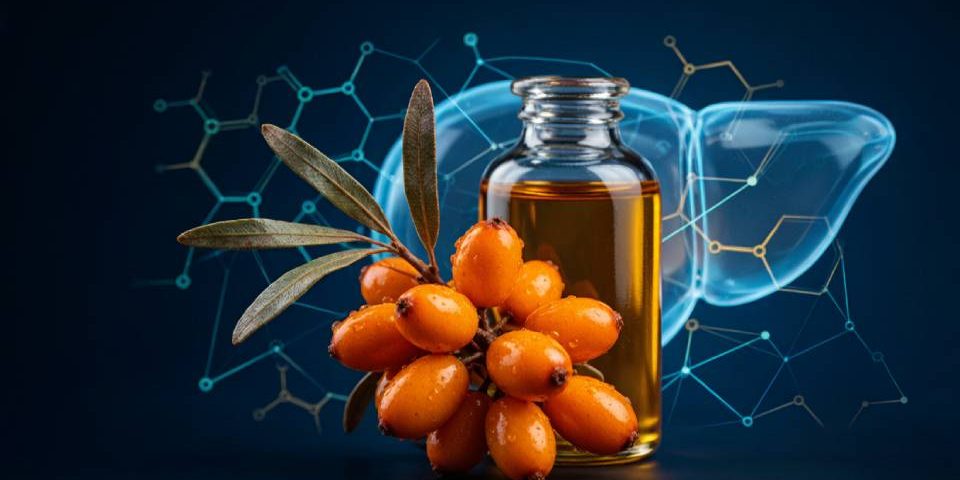
Sea buckthorn oil exists in two distinct forms — fruit oil (FO), dominated by monounsaturated palmitoleic acid (C16:1 n-7), and seed oil (SO), rich in polyunsaturated linoleic and α-linolenic acids. But which form is better for liver protection? A 2025 study by Guo Jianfeng, Qin Xuwei, and Wang Fang at North University of China answers that question: neither alone — it is the ratio that matters. A 6:4 blend of FO and SO achieves the optimal fatty acid balance (UFA/SFA≈3, PUFA/MUFA≈1, n-6/n-3≈2) and delivers superior protection against alcoholic liver disease through gut microbiota modulation.
Alcoholic Liver Disease and the Fatty Acid Question
Alcoholic liver disease (ALD) is a spectrum of conditions — fatty liver, alcoholitis, fibrosis, and cirrhosis — triggered by alcohol’s toxic metabolites, principally acetaldehyde and reactive oxygen species (ROS). Its global burden is rising, particularly in China, where ALD incidence and mortality are projected to increase significantly through 2040.
Dietary fat composition is known to influence ALD progression. High saturated fatty acid (SFA) intake worsens hepatic injury; certain polyunsaturated fatty acids (PUFAs), especially n-3 PUFAs from flaxseed and walnut oil, can attenuate ALD. Monounsaturated fatty acids (MUFAs) present a more nuanced picture: camellia seed oil (rich in oleic acid, MUFA) protected against alcohol-induced liver injury in mice, while olive oil (also MUFA-rich) exacerbated hepatic steatosis in the same model — suggesting that the specific MUFA source and the full fatty acid ratio profile, not just MUFA content alone, determines outcome.
Sea buckthorn oil is exceptional because it contains all four fatty acid classes — SFA, MUFA (especially the rare n-7 palmitoleic acid), n-6 PUFA, and n-3 PUFA — across its two commercially available forms. This makes it an ideal model system to study what fatty acid ratios, rather than individual components, do to ALD. That is precisely the question this study set out to answer.
Study Design at a Glance: 50 male Kunming mice were divided into 5 groups — normal control (NC), ALD model control (AC), and three sea buckthorn oil intervention groups (FO, SO, MO). ALD was induced over 6 weeks with escalating ethanol concentrations (25%→45%). All oil interventions were administered at 0.6 g/kg body weight/day (equivalent to ~3.6 g/day for an adult human). The mixed oil (MO) was prepared by blending FO:SO at a volume ratio of 6:4.
The Three Oils: How Their Fatty Acid Profiles Differ
The researchers first characterized the complete fatty acid composition of all three oils. The differences are striking and biologically meaningful:
| Fatty Acid | Mixed Oil (MO) | Fruit Oil (FO) | Seed Oil (SO) |
|---|---|---|---|
| C16:0 (Palmitic) | 23.0% | 30.8% | 8.6% |
| C16:1 n-7 (Palmitoleic) | 22.3% | 38.9% | 0.6% |
| C18:1 n-9 (Oleic) | 13.8% | 12.9% | 23.0% |
| C18:2 n-6 (Linoleic) | 25.1% | 13.0% | 36.1% |
| C18:3 n-3 (α-Linolenic) | 12.9% | 2.8% | 27.9% |
| ∑SFA | 25.7% | 33.2% | 11.3% |
| ∑MUFA | 36.3% | 51.9% | 23.9% |
| ∑PUFA | 38.0% | 15.8% | 64.8% |
| n-6 / n-3 ratio | 1.95 (≈2) | 4.72 | 1.29 |
| UFA / SFA | 2.89 (≈3) | 2.04 | 7.89 |
| PUFA / MUFA | 1.05 (≈1) | 0.30 | 2.71 |
| SFA : MUFA : PUFA | 1 : 1.41 : 1.48 | 1 : 1.56 : 0.47 | 1 : 2.13 : 5.76 |
The key finding: MO is the only oil that contains all four n-3, n-6, n-7, and n-9 fatty acid families in meaningful quantities. Its UFA/SFA≈3 avoids the extremes of FO (too SFA-heavy) and SO (too PUFA-skewed). Its PUFA/MUFA≈1 reflects near-equal distribution of the two major unsaturated types. And its n-6/n-3≈2 sits within the range increasingly recommended in nutritional science — contrasting sharply with FO’s n-6/n-3 of 4.72.
Liver Protection: What the Data Show
Liver Index and Tissue Pathology
Chronic alcohol exposure caused liver enlargement in the ALD model group (liver index 0.046 vs. 0.039 in healthy controls, P<0.05). After 6 weeks of MO intervention, the liver index recovered to 0.038 — statistically indistinguishable from healthy controls. FO and SO intervention groups showed downward trends but failed to reach statistical significance compared to the ALD model. Gross examination showed extensive surface hemorrhage, indentations, and pallor in ALD mice; MO-treated livers showed the most complete structural recovery, with H&E staining confirming dramatic reduction in intracellular lipid droplet accumulation.
Oxidative Stress Markers
Alcohol metabolism generates massive quantities of acetaldehyde and ROS, overwhelming the liver’s antioxidant defenses. The study tracked four key oxidative stress indicators:
| Marker | Normal (NC) | ALD Model (AC) | Mixed Oil (MO) | Fruit Oil (FO) | Seed Oil (SO) |
|---|---|---|---|---|---|
| MDA (nmol/g) ↓ | 0.91 | 1.58 | 1.16 | 1.48 | 1.43 |
| MPO (U/g) ↓ | 1.15 | 2.20 | 1.37 | 1.93 | 1.77 |
| SOD (U/g) ↑ | 1.87 | 1.16 | 1.39 | 1.47 | 1.40 |
| GSH (μg/g) ↑ | 440.7 | 351.8 | 419.6 | 395.0 | 377.4 |
MO reduced MDA by 26.6% versus the ALD model — a dramatic reversal of lipid peroxidation. Its restoration of GSH to 419.6 μg/g (vs. 351.8 in ALD model) represents a near-complete recovery of the glutathione antioxidant pool. Critically, MO’s improvement in MDA, MPO, and GSH was statistically superior to both FO and SO (P<0.05), while FO and SO showed only partial, less consistent improvements.
Inflammatory Cytokines
Excess lipid accumulation triggers hepatic inflammation, a critical step in ALD progression from fatty liver to hepatitis. The study measured three key pro-inflammatory cytokines:
| Cytokine | Normal (NC) | ALD Model (AC) | Mixed Oil (MO) | Fruit Oil (FO) | Seed Oil (SO) |
|---|---|---|---|---|---|
| TNF-α (pg/mL) ↓ | 75.57 | 127.93 | 92.51 | 115.78 | 116.62 |
| IL-6 (pg/mL) ↓ | 387.7 | 589.3 | 416.7 | 516.8 | 527.6 |
| IL-1 (pg/mL) ↓ | 63.83 | 110.85 | 74.08 | 82.08 | 79.10 |
MO reduced TNF-α by 27.7% versus the ALD model. For all three cytokines — TNF-α, IL-6, and IL-1 — MO’s reduction was significantly greater than FO and SO (P<0.05). FO and SO achieved only modest cytokine suppression, with IL-6 and TNF-α remaining elevated close to ALD model levels. This pattern is consistent across all liver injury biomarkers: MO’s balanced fatty acid profile consistently outperforms both single-source oils.
The Gut-Liver Axis: How Sea Buckthorn Oil Modulates Microbiota
The gut-liver axis is now recognized as a central pathway in ALD progression. Approximately 30% of alcohol-derived acetaldehyde is metabolized in the liver; the remainder reaches the gastrointestinal tract via bile excretion, where it disrupts the microbiome, increases gut permeability, and drives systemic endotoxemia. This study’s gut microbiota analysis reveals a compelling mechanism for MO’s superior protective effect.
Alcohol Disrupts the Microbiome — and MO Reverses It
ALD mice showed a dramatic expansion of the gut microbiome: 1,941 OTUs (operational taxonomic units) vs. 1,663 in healthy controls, with 1,066 unique to the ALD group — indicating substantial microbial community reshaping. At the phylum level, ALD caused decreases in Firmicutes and Actinobacteria and increases in Bacteroidetes and Proteobacteria. SO intervention completely reversed this phylum-level shift; MO showed similarly effective correction.
Erysipelotrichaceae: A Key Microbial Marker
The most important finding at the family level was the dramatic overgrowth of Erysipelotrichaceae in ALD mice. This family is immunogenic, known to proliferate after broad-spectrum antibiotic treatment, and — crucially — its relative abundance correlates positively with both TNF-α levels and hepatic lipid accumulation. In mice with parenteral nutrition-associated liver injury, Erysipelotrichaceae shows mass proliferation. This study observed the same positive correlation between Erysipelotrichaceae abundance and liver fat/TNF-α in ALD mice.
Critical Finding: MO intervention significantly reduced Erysipelotrichaceae abundance back toward healthy-control levels. FO had no significant effect on this taxon. SO showed partial correction. This microbiota-level difference may be the mechanistic link between MO’s balanced fatty acid ratio and its superior liver protection — mediated through the gut-liver axis.
The Proposed Protective Mechanism
Based on the comprehensive data, the authors propose the following pathway connecting MO’s fatty acid balance to liver protection:
Profile (MO)
Rebalancing
↓ Lactobacillaceae
↓ Endotoxin Load
↓ MDA · ↓ MPO
Antioxidant Defense
↓ IL-1
Inflammation
Three Oils Side by Side: Why the Ratio Wins
🏆 Mixed Oil (MO)
- FO:SO = 6:4 blend
- UFA/SFA≈3 (balanced)
- PUFA/MUFA≈1 (balanced)
- n-6/n-3≈2 (optimal)
- All four FA families present
- MDA ↓26.6% vs ALD model
- TNF-α ↓27.7% vs ALD model
- Liver index = 0.038 (normal range)
- Erysipelotrichaceae fully reversed
🫐 Fruit Oil (FO)
- Rich in palmitoleic acid (C16:1 n-7)
- SFA/MUFA/PUFA = 1:1.56:0.47
- PUFA severely low (15.8%)
- n-6/n-3 = 4.72 (imbalanced)
- Liver index: 0.042 (not significant)
- MDA: 1.48 (partial improvement)
- No effect on Erysipelotrichaceae
- TNF-α: 115.78 (near-model level)
🌿 Seed Oil (SO)
- Rich in linoleic & α-linolenic acid
- PUFA very high (64.8%)
- n-6/n-3 = 1.29 (low, n-3 heavy)
- SFA/MUFA/PUFA = 1:2.13:5.76
- Liver index: 0.040 (partial)
- MDA: 1.43 (partial improvement)
- Partial Erysipelotrichaceae correction
- TNF-α: 116.62 (near-model level)
Formulation & Sourcing Implications for B2B Buyers
This research establishes a clear principle for functional food and nutraceutical formulators: sea buckthorn oil’s hepatoprotective efficacy is ratio-dependent. Sourcing a single-form oil (FO or SO) and relying on its individual fatty acid profile will deliver sub-optimal results. The 6:4 FO:SO blend that achieves UFA/SFA≈3 and PUFA/MUFA≈1 is the scientifically validated target.
Liver Health Supplements
Soft gel capsules, liquid shots, or tinctures targeting ALD prevention, liver detox support, or post-alcohol recovery — backed by peer-reviewed in vivo data.
Gut Microbiome Products
Prebiotic-like ingredient for gut-liver axis support formulations. The documented reversal of Erysipelotrichaceae overgrowth positions sea buckthorn MO as a functional gut health ingredient.
Anti-Inflammatory Blends
TNF-α and IL-6 reduction data support positioning in systemic inflammation formulations, metabolic health products, and anti-inflammatory functional beverages.
Functional Food Enrichment
Lipid-based delivery systems, emulsified food formats, and cold-pressed oil blends for health food channels — positioned on clinical evidence rather than generic “superfood” marketing.
Custom Ratio Blending
TongyuBio supplies both fruit oil and seed oil separately, enabling formulators to achieve any target FA ratio. Custom 6:4 pre-blended MO also available. Certificate of Analysis with full GC fatty acid profiles provided.
Regulatory & Claims Support
Published 2025 Food and Fermentation Industries data (peer-reviewed, DOI-registered) and in vivo ALD model results available for dossier preparation and substantiation of structure-function claims.
Source Sea Buckthorn Oil with Full Fatty Acid Characterization
TongyuBio supplies both sea buckthorn fruit oil (palmitoleic-rich) and seed oil (PUFA-rich) with complete GC fatty acid profiles — enabling you to formulate precisely to the UFA/SFA≈3 target validated in this research. SC-CO₂ extracted, GLP-compliant, B2B bulk supply.
Frequently Asked Questions
What is the difference between sea buckthorn fruit oil and seed oil?
Sea buckthorn fruit oil (FO) is extracted from the flesh and pericarp of the berry and is uniquely rich in palmitoleic acid (C16:1 n-7, ~38.9%), an n-7 monounsaturated fatty acid rarely found in plant oils. Sea buckthorn seed oil (SO) is pressed from the seeds and is dominated by polyunsaturated fatty acids — primarily linoleic acid (C18:2 n-6, ~36.1%) and α-linolenic acid (C18:3 n-3, ~27.9%). The two oils have complementary fatty acid profiles, which is why blending them achieves a more balanced and clinically effective composition than either alone.
Why does the fatty acid ratio matter more than total fatty acid content?
This study demonstrated that the overall balance of fatty acid classes — not just the amount of any single type — determines liver-protective efficacy. Sea buckthorn seed oil has excellent n-3 PUFA content, but its extreme PUFA/MUFA ratio (2.71) and very low SFA content create an imbalanced profile. Fruit oil’s high palmitoleic content is valuable, but its negligible PUFA supply and n-6/n-3 imbalance limit its anti-inflammatory potential. The 6:4 mixed oil achieves a compositional profile where all four fatty acid families are present in proportions that work synergistically — reflected in its superior performance across every measured biomarker.
What is Erysipelotrichaceae and why does its reduction matter?
Erysipelotrichaceae is a bacterial family in the gut microbiome with strong immunogenic properties. Its relative abundance correlates positively with systemic TNF-α levels and hepatic lipid accumulation. In ALD, chronic alcohol exposure causes its dramatic overgrowth, contributing to the gut-liver axis dysregulation that drives disease progression. The observation that MO — but not FO — significantly reduced Erysipelotrichaceae abundance to near-normal levels provides a mechanistic explanation for MO’s superior anti-inflammatory effect: the balanced fatty acid ratio modulates gut microbiota composition in a way that breaks the dysbiosis-inflammation cycle.
What dose was used in the study, and how does it translate to humans?
The mice received 0.6 g/kg body weight per day of sea buckthorn oil. The authors note this is equivalent to approximately 3.6 g/day for an adult human — a dose achievable through dietary supplementation (roughly one soft gel capsule formulated at 1.2g per capsule, three times daily). This is a conservative and commercially realistic dose, making the findings directly relevant to supplement and functional food product development.
How does this study compare to previous sea buckthorn oil liver research?
Previous research by the same group (Wang Fang et al., 2025, Journal of Shanxi Agricultural University) established that a mixed sea buckthorn oil dose of 0.6 g/kg bw effectively protected against chronic alcohol-induced liver injury and modulated gut microbiota. The current study builds on that foundation by systematically characterizing the fatty acid compositions of all three oil forms and demonstrating — for the first time — that the protective superiority of the mixed oil is directly attributable to its balanced fatty acid ratio profile (UFA/SFA≈3, PUFA/MUFA≈1, n-6/n-3≈2) rather than to any single component.
Does TongyuBio supply the 6:4 mixed oil pre-blended, or only separate oils?
TongyuBio supplies sea buckthorn fruit oil and seed oil as separate, fully characterized bulk ingredients, allowing formulators to achieve any target fatty acid ratio for their specific application. Pre-blended mixed oil at customized ratios is available on request for customers who prefer a ready-to-use format. All products come with a complete GC fatty acid profile Certificate of Analysis. Contact our technical team to discuss your formulation requirements and request samples.
Guo Jianfeng, Qin Xuwei, Zhao Purun, Li Bowen, Huo Nairui, Wang Fang. Fatty acid ratios in sea buckthorn oil: Protection against alcoholic liver disease and gut microbiota regulation [J]. Food and Fermentation Industries, 2025, 51(24): 269–275. DOI: 10.13995/j.cnki.11-1802/ts.043812
Supporting References (selected)[1] Osna NA, et al. Pathogenesis of alcohol-associated liver disease. J Clin Exp Hepatol. 2022;12(6):1492–1513.
[2] Bataller R, Arab JP, Shah VH. Alcohol-associated hepatitis. N Engl J Med. 2022;387(26):2436–2448.
[3] Tang ZZ, et al. Epidemiological characteristics of alcohol-related liver disease in China. BMC Public Health. 2023;23(1):1276.
[4] Guo R, et al. Dietary camellia seed oil attenuates liver injury in mice chronically exposed to alcohol. Front Nutr. 2022;9:1026740.
[5] Guo R, et al. Monounsaturated fatty acid-enriched olive oil exacerbates chronic alcohol-induced hepatic steatosis. Food & Function. 2023;14(3):1573–1583.
[6] Fu YJ, et al. Coordinated action of a gut-liver pathway drives alcohol detoxification and consumption. Nature Metabolism. 2024;6(7):1380–1396.
[7] Bajaj JS. Alcohol, liver disease and the gut microbiota. Nat Rev Gastroenterol Hepatol. 2019;16(4):235–246.
[8] Kaakoush NO. Insights into the role of Erysipelotrichaceae in the human host. Front Cell Infect Microbiol. 2015;5:84.
[9] Wang F, Zhang B, Zhang X, et al. Regulatory effects of sea buckthorn mixed oil on chronic alcohol-induced liver injury and intestinal microbiota in mice. J Shanxi Agric Univ (Nat Sci Ed). 2025;45(2):39–49.
