
Astaxanthin Liposome Delivery Study
October 11, 2026
Spermidine: The Natural Anti-Aging Ingredient Backed by Autophagy Science
October 25, 2026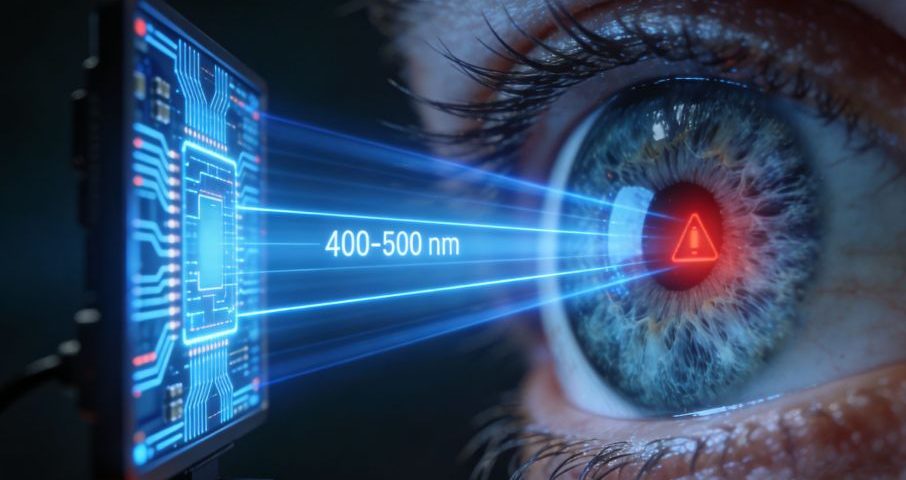
Eye-health formulas almost always start with lutein — and then the question becomes how much more you have to add to make a label claim feel credible. A 2025 in vitro study from Jinan University tested the other direction: less of each nutrient, but combined. A lutein ester–astaxanthin complex — laced with zeaxanthin and traditional goji and cassia-seed powders — was pitted against single-nutrient lutein in human retinal pigment epithelial (ARPE-19) cells under blue LED light. The complex, at carotenoid intakes far below the lutein-only reference, matched or beat it on every endpoint measured: cell viability, membrane damage, and intracellular reactive oxygen species. For formulators buying astaxanthin and lutein ingredients for eye-positioned products, the data below are a working case for the “low-dose complex” strategy.
01Why blue light is a formulation problem, not just a marketing one
Blue light sits at the 400–500 nm end of the visible spectrum, where photon energy is highest. It passes through the cornea and lens and reaches the retina directly — and the retinal pigment epithelium (RPE), the outermost retinal layer that maintains the photoreceptors, is particularly sensitive to it.
The mechanism is oxidative. Blue light drives excess reactive oxygen species (ROS) production inside RPE cells — from the mitochondrial electron-transport chain and from NADPH oxidase enzymes — and because RPE cells are naturally high-oxygen-consumption cells, the ROS overload tips them into oxidative stress: membrane damage, loss of viability, and eventually cell death. That chain of events is why blue-light exposure is one of the most-studied oxidative models in retinal cell research, and why screen-time anxiety has become a market reality for eye-health supplements.
Humans cannot synthesize carotenoids — every molecule in the macula came from the diet. The macular pigments lutein and zeaxanthin accumulate in the retina, where they both filter short-wavelength light and quench ROS; the keto-carotenoid astaxanthin (sourced commercially from Haematococcus pluvialis) is one of the most aggressive singlet-oxygen quenchers among natural carotenoids and is widely used in antioxidant positioning. In Chinese eye-health formulas, these are classically paired with goji berry and cassia seed — two botanicals with long traditional “bright-eye” reputations.
02How the study was built
The researchers used the ARPE-19 human RPE cell line — the standard in vitro model for retinal oxidative-stress work — and a custom blue LED exposure rig: 450 ± 20 nm at roughly 2 mW/cm², 12 hours of continuous exposure, enough to produce clear photo-oxidative damage in untreated cells.
Six groups ran in parallel:
- Control — no light stress, no treatment
- Damage — blue light, untreated
- Reference — lutein alone, at the study’s reference concentration
- Low / Medium / High — the lutein ester–astaxanthin complex at three dose levels
Complex pre-treatment ran for 6 hours before light exposure. The complex itself was a five-ingredient formula:
| Component (assay purity) | Low dose | Medium dose | High dose |
|---|---|---|---|
| Lutein ester extract (99%) | 2 mg | 4 mg | 6 mg |
| Astaxanthin extract (98%) | 1 mg | 2 mg | 3 mg |
| Zeaxanthin (99%) | 0.3 mg | 0.6 mg | 0.9 mg |
| Goji (wolfberry) powder | 1 mg | 2 mg | 3 mg |
| Cassia seed powder | 1 mg | 2 mg | 3 mg |
Formula per the study’s dosing table (Zhao & Wu, 2025). The reference group received lutein alone; the paper prints its concentration as 0.5 g/mL, which at face value would be implausible in cell culture (we read it as mg/mL) — worth verifying against the original before citing the absolute figure.
Three endpoints were measured per group: MTT cell viability, LDH release (lactate dehydrogenase leaking through damaged membranes — a direct membrane-damage readout), and intracellular ROS via DCFH-DA fluorescence.
03What the cells showed: viability and membrane damage
Blue light did its job in the damage group: viability fell by 54.8% versus control (P < 0.001), and LDH release — the marker of ruptured membranes — rose by 55.5%. Every pre-treated group pushed back significantly:
| Group (vs damage group) | Cell viability | LDH release | Intracellular ROS |
|---|---|---|---|
| Reference — lutein alone | +32.9% | −35.7% | −34.5% |
| Low-dose complex | +17.2% | −14.3% | −23.5% |
| Medium-dose complex | +25.9% | −30.0% | −32.8% |
| High-dose complex | +36.9% | −37.3% | −48.2% |
Damage group itself: −54.8% viability, +55.5% LDH and +156.7% ROS versus untreated control. All listed treatment effects are significant at P < 0.001 versus the damage group. Data: Zhao & Wu, Food Research and Development, 2025, 46(5): 80–86.
The ROS column is where the complex earned its keep. Blue light more than doubled intracellular ROS in untreated cells (+156.7%); the high-dose complex cut that back by nearly half (−48.2% versus the damage group) — a larger reduction than the lutein-only reference achieved (−34.5%), with a fraction of the lutein-equivalent load and astaxanthin contributing only 1–3 mg of the formula.
The question is not how much lutein you can afford to add. It is how little of each carotenoid you need when they work together.
04The synergy argument: matched at a fraction of the dose
The study’s framing is blunt: the reference group received single-nutrient lutein at a comparatively large dose, while the complex delivered its carotenoids at much lower individual levels — and still matched the reference on viability and LDH, and exceeded it on ROS clearance. That is the working definition of a formulation synergy: same or better endpoint, materially less of each expensive ingredient. For a costed BOM, this is the difference between a hero dose you cannot afford and a complex dose you can.
The authors’ mechanistic reading is that the esterified lutein and the keto-carotenoid astaxanthin intervene at different points of the same oxidative cascade — light filtering and singlet-oxygen quenching in the lipid phase, plus complementary radical-scavenging geometry — so the combination covers more of the damage pathway than any single pigment saturating one step. The goji and cassia powders add polysaccharide-class antioxidants on top.
It is also worth reading the dose column honestly: the low-dose complex, while clearly better than nothing, was the weakest group on every endpoint. The complex strategy works, but it is not license to under-dose — the study’s own data show a clean dose-response across low → medium → high.
05What this study does — and does not — establish
Honest boundaries, because they are what make the data usable:
- It is an in vitro cell model. ARPE-19 cells under 12 hours of continuous blue LED exposure are a screening model, not a clinical scenario. No human dose, no eye-health claim for finished products follows from these numbers alone.
- The study also ran tissue-level endpoints in an animal model (antioxidant-enzyme activity and tissue morphology). Those in vivo results are outside the scope of this article and are not reproduced here; see the original publication for them. The authors report the in vitro findings above as the basis for the complex’s formulation logic.
- The reference comparison is against lutein alone at one concentration — a useful benchmark, not a full dose-response curve of lutein itself.
06What it means for an eye-health formula BOM
For product teams writing an eye-health or screen-life-positioned formula, the practical takeaways:
- Pair your lutein with a keto-carotenoid. The ROS data are the strongest argument in the paper for adding 1–3 mg-class astaxanthin alongside lutein ester rather than raising the lutein dose.
- Specify the ester form deliberately. The study chose lutein ester, not free lutein, for the complex — esters are the native form in marigold extracts and carry cost and stability advantages; free lutein was reserved for the reference arm.
- Keep zeaxanthin in the pair. It was dosed at 15–30% of the lutein-ester level in the study’s formula — the same ratio family the macula itself maintains between lutein and zeaxanthin.
- Demand the model, not the adjective. “Anti-blue-light” means nothing on a supplier document; “reduced blue-light-induced ROS in ARPE-19 cells by X% at Y µg/mL” is something your R&D team can build on.
07Sourcing the ingredients
TongyuBio supplies Haematococcus pluvialis astaxanthin powder, supercritical CO₂-extracted, UV-assayed from 1.5% to 5% across seven concentration grades — with the higher grades (3.5–5%) typically specified for targeted eye-health and premium antioxidant formulas, where the active occupies less capsule real estate per milligram of carotenoid delivered. Lutein- and zeaxanthin-based ingredients and other eye-formulation actives sit in the encapsulated powders portfolio, which also solves the stability side of the problem: carotenoids are light- and oxygen-sensitive, and encapsulation is what keeps a five-ingredient complex alive through shelf life.
When requesting a quote for an eye-formulation build, have your spec sheet ask for: astaxanthin content by UV with method, carotenoid-ratio flexibility, heavy metals and solvent residues, and encapsulation format options — the same COA-plus logic we detail in our astaxanthin liposome delivery study.
08Frequently Asked Questions
Does astaxanthin protect eyes from blue light?
In the 2025 in vitro study, astaxanthin as part of a lutein ester–astaxanthin complex reduced blue-light-induced oxidative stress in ARPE-19 human retinal cells: intracellular ROS fell by up to 48.2% versus untreated cells. This is cell-model data supporting ingredient selection for eye-positioned formulas — not clinical evidence of eye protection in humans, and not a basis for a consumer efficacy claim.
Is a lutein–astaxanthin combination better than lutein alone?
In the study’s ARPE-19 blue-light model, the complex matched the lutein-only reference on cell viability and membrane damage, and outperformed it on ROS clearance (−48.2% vs −34.5% versus the damage group) — while delivering each carotenoid at much lower individual levels. That supports a “low-dose complex” formulation strategy, with the caveat that it is a single in vitro comparison at one reference concentration.
How much astaxanthin was in the study’s complex?
The astaxanthin extract (98% assay) accounted for 1, 2 and 3 mg in the low-, medium- and high-dose formulas respectively — alongside lutein ester (2–6 mg), zeaxanthin (0.3–0.9 mg), goji powder and cassia-seed powder. In finished-product terms these are compact, costable doses for a multi-carotenoid eye formula.
Why lutein ester instead of free lutein?
Lutein ester is the native form in marigold-derived extracts; it is generally more stable and more cost-efficient per unit of lutein-equivalent, and the study deliberately used the ester in the complex while reserving free lutein for the single-nutrient reference arm. Formulators typically weigh ester cost/stability against the free form’s established use in legacy products.
Can these results support a “blue light protection” label claim?
No. In vitro ARPE-19 data can support internal formulation decisions and supplier selection, but a consumer-facing blue-light claim requires finished-product evidence and market-specific regulatory review (FDA/EFSA rules on structure-function and health claims differ and both restrict device- or disease-oriented claims).
