
Eucommia Seed Oil: A Rare Chinese Botanical Rich in Alpha-Linolenic Acid
April 23, 2026
Eucommia Seed Oil: 61% Alpha-Linolenic Acid & #1 Antioxidant Among 11 Vegetable Oils
April 25, 2026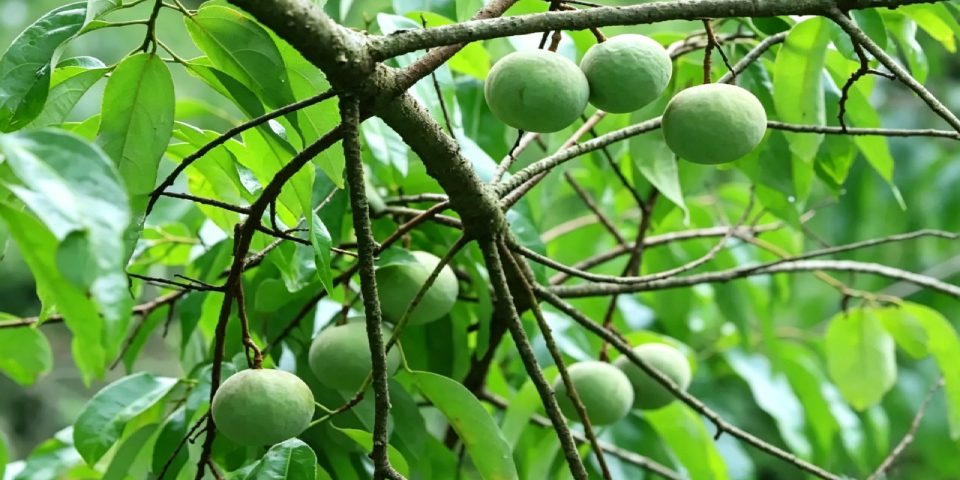
Botanical Ingredient Spotlight
Deep in the karst mountains of southern China grows a tree so rare that few outside the region have ever heard of it — yet its seeds produce one of the highest concentrations of nervonic acid found in any plant on earth, making it a prized raw material for brain-health and neuroprotective formulations worldwide.
Malania oleifera, an ancient evergreen tree of the Olacaceae family, is endemic to China — found only in the karst regions of Yunnan and Guangxi provinces. Its seed kernel oil contains 33–56% nervonic acid (C24:1), a very-long-chain monounsaturated fatty acid that serves as a core natural component of brain nerve fibers and nerve cells, playing an essential role in immune function, lipid metabolism regulation, and central nervous system health.
At TongyuBio, we help brands and formulators access high-quality plant-derived nervonic acid and specialty seed oils. This article reviews the nutritional composition, fatty acid profile, and emerging product applications of Malania oleifera based on the latest peer-reviewed literature.
By The Numbers
Why Malania oleifera Stands Out
Key figures that make this rare Chinese tree a rising star in the nutraceutical industry.
Background
What Is Malania oleifera?
A Chinese endemic evergreen tree found only in the karst landscapes of Yunnan and Guangxi — every part of the tree has application potential.
Malania oleifera (family Olacaceae, genus Malania) is an evergreen tree species found exclusively in southeastern Yunnan and the karst regions of Guangxi in China. Also known as “shantouguo” or “malanhou”, it is recognized as one of China’s unique ancient oil-bearing species. A 2023 survey identified wild populations across 19 counties in Guangxi and 3 counties in Yunnan, with Guangxi alone hosting over 200,000 individual trees.
By 2021, Yunnan Province had established approximately 2,000 hectares (30,000 mu) of cultivated Malania oleifera. The tree thrives in warm, humid climates and exhibits strong ecological adaptability to karst environments, making it a valuable species for both vegetation restoration in rocky desertification areas and commercial cultivation. Importantly, every part of the tree — from root to fruit — holds research and application value: seed kernels yield oil, nervonic acid, and protein; shells and peels contain lignans and crude fat; leaves are rich in flavonoids and volatile oils; and roots contain antimicrobial compounds.
Nutritional Profile
Seed Kernel Oil: Rich in Nervonic Acid
The seed kernel is the primary utilized part — its oil content and nervonic acid concentration rival or exceed most known plant sources.
The seed kernel of Malania oleifera is remarkably oil-rich. Across different regions in Guangxi and Yunnan, oil content ranges from 40.28% to 65.00%, with an average of 56.73%. The highest recorded oil content was found in Bama, Guangxi (65.00%), while the lowest was in Longlin, Guangxi (40.28%). Research indicates that oil content correlates positively with longitude but negatively with latitude and altitude, suggesting that growing conditions significantly influence yield.
| Region | Province | Oil Content (%) |
|---|---|---|
| Fengshan | Guangxi | 58.15 |
| Tianlin | Guangxi | 58.65 |
| Longlin | Guangxi | 40.28 |
| Bama | Guangxi | 65.00 |
| Leye | Guangxi | 52.70 |
| Guangnan | Yunnan | 58.15 |
| Funing | Yunnan | 64.16 |
| Average | 56.73 | |
The dominant fatty acids in the oil are nervonic acid (C24:1) and oleic acid (C18:1). Nervonic acid content ranges from 33.17% to 55.70% across regions, while oleic acid ranges from 23.81% to 30.81%. Together, these two fatty acids account for approximately 70–80% of total fatty acids. Nervonic acid is a core natural component of brain nerve fibers and nerve cells, essential for immune enhancement, lipid and blood sugar regulation, and central nervous system maintenance. Oleic acid contributes additional benefits including lipid regulation, anti-inflammatory, antimicrobial, and antioxidant properties.
Studies have shown that nervonic acid content correlates positively with mean annual temperature, annual precipitation, and longitude, but negatively with altitude. The oil also exhibits a favorable ratio coefficient of up to 77.25, indicating high nutritional value suitable for dietary supplement and functional food applications.
Detailed Analysis
Fatty Acid Composition
A comparison of major fatty acids across multiple growing regions in Guangxi and Yunnan.
| Fatty Acid | Tianlin, GX | Bama, GX | Guangnan, YN | Funing, YN |
|---|---|---|---|---|
| Palmitic (C16:0) | 0.59 | 0.45 | 0.55 | 0.53 |
| Stearic (C18:0) | 0.24 | 0.28 | 0.20 | 0.23 |
| Oleic (C18:1) | 29.78 | 23.81 | 30.81 | 29.74 |
| Linoleic (C18:2) | 1.44 | 0.53 | 1.52 | 1.54 |
| Linolenic (C18:3) | 1.94 | — | 0.82 | 0.55 |
| Eicosenoic (C20:1) | 15.38 | 1.28 | 2.21 | 1.97 |
| Erucic (C22:1) | — | 13.13 | 15.20 | 14.14 |
| Nervonic (C24:1) | 44.89 | 55.70 | 44.21 | 45.04 |
“—” indicates the compound was not detected in that sample. Data compiled from multiple GC-MS analyses across Guangxi and Yunnan.
Beyond Oil
Protein, Minerals & Bioactive Compounds
The seed kernel and other plant parts contain a diverse array of nutrients with significant commercial potential.
Beyond its impressive oil content, the Malania oleifera seed kernel contains 9.6–21.02% protein. The unique protein isolated from this species — named Malanin — is a glycoprotein with a molecular weight of 61,875 Da. It is classified as an α+β type protein with a stable cis-conformational structure, and Ca²⁺ helps maintain its natural conformation. Notably, Malanin contains 17 amino acids, providing a complete amino acid profile.
Mineral Elements
Seed kernels are rich in K (12.12 mg/g), Mg (2.259 mg/g), and Ca (0.1926 mg/g). The high potassium, low sodium profile makes it suitable for “high-K, low-Na” food and feed applications.
Flavonoids & Polysaccharides
Leaves yield up to 16.78% total flavonoids via ethanol reflux extraction. Seed kernels contain 0.60% polysaccharides and 0.26 mL/100g volatile oil, contributing to the tree’s broad bioactive profile.
Antimicrobial Compounds
Root extracts demonstrate antibacterial activity against human pathogens including Staphylococcus haemolyticus, Streptococcus agalactiae, and Bacillus cereus, indicating pharmaceutical potential.
The shells and peels of the fruit also hold value — crude fat extraction yields reach 6.47% for shells and 6.60% for peels, while shell lignans can be extracted at a yield of 1.148%. This means the entire fruit can be utilized, supporting zero-waste processing models.
Applications
Emerging Product Applications
From brain-health supplements to natural food flavors — three major application pathways are driving Malania oleifera commercialization.
Malanin Protein — Cancer Research
Malanin, a novel glycoprotein isolated from Malania oleifera seeds, demonstrates high cytotoxicity against human cervical cancer HeLa cells and liver cancer HepG-2 cells, showing positive significance for cancer therapy. Researchers have identified its 3D structural similarity to ricin-type ribosome-inactivating proteins. Future research aims to use site-directed mutagenesis to reduce toxicity while retaining immunogenicity, potentially creating low-toxicity immunotoxins for clinical use. Yunnan University’s School of Medicine has already initiated R&D in this field.
Nervonic Acid Products — Brain Health
Nervonic acid is indispensable for brain nerve tissue and nerve cell growth, playing critical roles in immune enhancement, lipid and blood sugar regulation, central nervous system maintenance, and treatment of brain diseases. Since extracting nervonic acid from animal sources is challenging, plant-derived nervonic acid from Malania oleifera offers a more practical and sustainable supply. Current nervonic acid products include nervonic acid gel candies and pressed candies (co-developed by Guangnan County Malania oleifera Industry Association and Zhejiang University), nervonic acid capsules (by Nanjing Shengnuo Biotechnology), and nervonic acid nasal sprays and lozenges (developed by Kunming Medical University).
Natural Benzaldehyde — Food & Flavor Industry
Natural benzaldehyde is widely used as a food flavoring and preservative. Currently, bitter almonds serve as the main commercial source, but their low benzaldehyde content keeps production costs high. Malania oleifera offers a promising alternative: the volatile oil from fruit pulp contains up to 78.79% benzaldehyde, leaf oil reaches 61.88%, and nitrogen-protected vacuum distillation can achieve 98% purity at an 80.8% recovery rate. This makes Malania oleifera a highly competitive raw material for natural benzaldehyde production.
Summary
Market Potential & Challenges
Rich nutrition and diverse applications — but supply constraints and immature cultivation technology remain key hurdles.
Malania oleifera is a nutritionally rich plant with strong market potential across pharmaceutical, nutraceutical, and food industries. However, several challenges must be addressed: scarce wild resources, habitat degradation, and immature artificial cultivation techniques. The current product portfolio remains relatively limited — primarily nervonic acid extraction from seed kernels — and comprehensive utilization of shells, peels, leaves, and roots is still in its early stages. Moving forward, collaboration between government, enterprises, farmers, and researchers will be essential to advance breeding programs, optimize extraction processes, and develop a sustainable, full-value utilization model for this remarkable species.
🧠 Premium Nervonic Acid
33–56% nervonic acid content — one of the highest plant-derived concentrations globally
🔬 Novel Protein (Malanin)
Unique glycoprotein with demonstrated anticancer potential in vitro
🍋 Natural Benzaldehyde
Up to 78.79% benzaldehyde in fruit pulp — a viable alternative to bitter almond sourcing
♻️ Zero-Waste Potential
Every part of the tree — seeds, shells, peels, leaves, roots — has extractable bioactive compounds
FAQ
Frequently Asked Questions
Evidence Base
References
| # | Study | Key Finding |
|---|---|---|
| 1 | Wu R, et al. China Oils and Fats. 2025; 50(6):111–114 | Comprehensive review of nutritional components and product development |
| 2 | Huang X, et al. J For Environ. 2022; 42(6):663–672 | Seed morphology and fatty acid composition across regions |
| 3 | Wang S, et al. Sci Rep. 2021; 11:23605 | Fruiting characterization in wild individuals of M. oleifera |
| 4 | Su J, et al. Adv Compos Hybrid Mater. 2025; 5(2):1268–1279 | Fatty acid composition and thermal characteristics of seed oil |
| 5 | Yuan Y, et al. Toxins (Basel). 2024; 16(10):440 | 3D structural comparison of Malanin and ricin-type RIPs |
| 6 | Yang Y, et al. Guihaia. 2023; 43(3):515–526 | Nutritional component analysis of different plant parts |
| 7 | Li X, et al. Appl Chem. 2007; 24(8):968–970 | Volatile oil extraction and benzaldehyde content analysis |
| 8 | Zhang Y, et al. Anhui Agric Sci. 2016; 44(5):15–17 | GC-MS determination of fatty acids in M. oleifera oil |
Work With TongyuBio
Interested in Malania oleifera or Nervonic Acid?
We supply plant-derived nervonic acid and specialty seed oils with full batch traceability, flexible MOQ, and complete technical documentation. Contact us to discuss specifications or request a sample.
Contact Us for Samples →Disclaimer: This article is for scientific and educational purposes only and does not constitute medical advice, diagnosis, or treatment. Malania oleifera-derived products have not been evaluated or approved by the FDA or any national drug authority for the treatment of any disease. For specific health concerns, please consult a qualified healthcare professional.
