
Six Woody Seed Oils Optimized for Functional Blending
September 13, 2026
Angelica Root Oil and Neuroprotection: The Non-Phthalide Fraction Most Specs Miss
September 20, 2026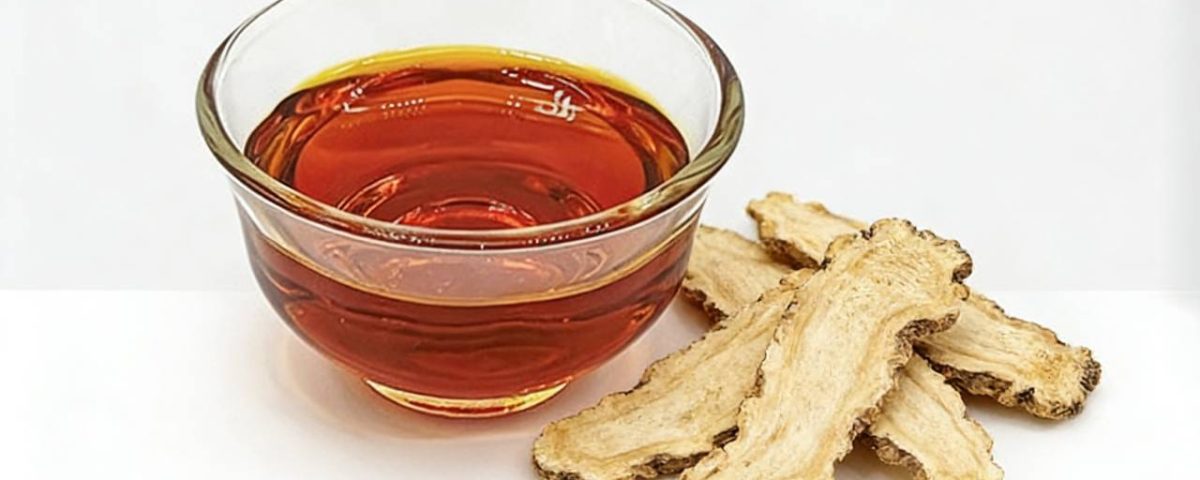
A landmark review from Gansu University of Chinese Medicine distills six years of research on Angelica sinensis volatile oil — and reveals why the extraction method, not just the plant, decides how much ligustilide ends up in your ingredient.
Angelica sinensis (Oliv.) Diels, known in Chinese as danggui (当归), is one of the most widely used botanicals in Traditional Chinese Medicine. Its dried root is classically described as sweet and neutral, warm in nature, and used to tonify blood, activate circulation, regulate menstruation, relieve pain, and moisten the intestines. The volatile oil — the aromatic fraction obtained from the root — is one of its principal pharmacologically active components.
That oil is chemically complex. Since Liu Guosheng and colleagues first identified its acidic, phenolic, and neutral fractions in 1979, researchers have steadily mapped its composition, refining both extraction technology and quality-control methods. A 2018 review by Chen Zhenhe and colleagues at Gansu University of Chinese Medicine and the Gansu Provincial Key Laboratory of Pharmacology and Toxicology for Traditional Chinese Medicine consolidated the 2010–2016 literature on angelica root oil — covering extraction, chemistry, quality identification, formulation technology, and pharmacology across multiple body systems.
For formulators, the practical takeaway is this: two bottles of “angelica root oil” can differ enormously in ligustilide content depending on how they were made, when the root was harvested, where it was grown, and how it was dried. This article walks through what the review found — and what it means when you’re specifying bulk angelica root oil for a supplement, skincare, or functional food product.
01Why the Volatile Oil Matters
Danggui root contains both water-soluble and volatile constituents, but the volatile oil carries a distinctive set of activities: smooth-muscle relaxation, cardiovascular effects, anti-asthmatic activity, skin-penetration enhancement, gastrointestinal regulation, and analgesic/anti-inflammatory action. It is also the fraction responsible for the root’s characteristic aroma.
The review highlights an important scientific caveat: while the pharmacological profile of the oil is broad and well documented in animal models, the specific active constituents and their mechanisms are not yet fully resolved. The authors specifically call for deeper investigation of the phthalide class — especially ligustilide (藁本内酯), the dominant compound — to clarify how individual molecules contribute to the oil’s overall activity.
Why this matters commercially: An ingredient whose activity depends on a single dominant, unstable molecule (ligustilide) is only as good as its extraction and handling process. The review’s extraction and quality data are therefore directly relevant to angelica root oil specification work — not just academic background.
02Two Extraction Routes: Steam Distillation vs. Supercritical CO₂
Steam Distillation (水蒸汽蒸馏法)
Steam distillation is the classical method, based on Dalton’s law: steam is passed through a water-immiscible, volatile organic material so the oil co-distills at a temperature below 100 °C. The variables that matter most are distillation time, liquid-to-solid ratio, and soak time.
Yang Rongping’s group found that both distillation time and particle size significantly affect yield. Longer soaking improved extraction rate; the effect of milling degree rose up to 10 mesh and then fell beyond it. Their optimized process: 10-mesh powder, 10× water, 3-hour soak, 8-hour distillation, 0.5% yield. Zheng Weiran’s orthogonal study (L9(3⁴)) identified sodium chloride addition, distillation time, and water volume as the three influencing factors in descending order — with NaCl affecting not only yield but ligustilide content. Optimal: liquid-to-solid 6:1, 8 h distillation, NaCl at 1/5 of the drug mass.
Supercritical CO₂ Extraction (超临界萃取法)
Supercritical CO₂ exploits the selective solvation power of supercritical carbon dioxide, fractionating compounds by polarity, boiling point, and molecular weight under varying pressure and temperature. It is faster and higher-yielding — but pressure, temperature, and time must be tightly controlled.
- Li Xiaoning et al.: using oil yield plus ligustilide as combined indicators, the factor hierarchy was extraction time > pressure > temperature. Optimum 30 MPa, 50 °C, 2 h delivered 1.41% oil yield with 42.12% ligustilide.
- Jin Yuanbao et al.: extraction rate rose from 35–45 °C then declined; time rose up to 1.5 h then plateaued; pressure rose from 20–30 MPa then fell. Using a Box-Behnken design, the optimized conditions were 44.4 °C, 32.37 MPa, 1.48 h — achieving a 2.0833% extraction rate with strong antimicrobial activity.
- Li Lingjun: particle size matters — finer grinding raised both extraction efficiency and ligustilide recovery. Optimum used 4-mesh coarse powder at 30 MPa, 65 °C, 20 kg/h flow, 2 h, with two-stage separation (12 MPa/40 °C and 6 MPa/40 °C).
Head-to-Head: Method Changes the Molecule
The review’s most commercially important finding is that the two methods yield chemically different products — not just different quantities. Supercritical CO₂ consistently delivers higher yields and substantially more ligustilide:
| Comparison | Steam Distillation | Supercritical CO₂ |
|---|---|---|
| Ligustilide recovery (Li Donghua) | 55.89% | 78.19% |
| Components identified (Li Donghua) | 29 | 25 |
| Components identified — Minxian material (Fan Qin) | 73 | 25 |
| Volatile oil fraction (Fan Qin) | 58.99% | 63.43% |
| Ligustilide mass fraction (Fan Qin) | 25.60% | 48.29% |
The pattern is consistent: steam distillation tends to capture a wider spread of compounds, while supercritical CO₂ concentrates ligustilide. The authors attribute this to ligustilide’s instability at elevated temperature — sustained heating degrades it. Supercritical CO₂, operating at lower temperature and completing in 1.5–2 hours, better preserves the molecule.
For a supplement positioned on ligustilide content, this distinction is decisive. It is the reason angelica root oil specifications should state the extraction route, not just the Latin name.
03Chemical Composition: Ligustilide Dominates
Across studies, the volatile oil repeatedly resolves to a small set of dominant compounds — ligustilide, β-ocimene, α-pinene, and n-butylidenephthalide — with ligustilide usually in the overwhelming majority.
| Study | Method | Components | Ligustilide Share |
|---|---|---|---|
| Yang Jing et al. | Supercritical extraction + GC-MS | 31 | 79.829% |
| Zhou Wei et al. | Steam distillation + GC-MS | 30 | >80% |
| Li Tao & He Xuan (wild A. sinensis) | GC-MS | 55 | Not detected |
Two details are worth flagging. First, Yang Jing’s supercritical extract also quantified butylidenephthalide at 1.491%, while Zhou Wei’s steam-distilled oil found 3-n-butylidenephthalide, α-pinene, and β-ocimene all exceeding 1.0%.
Second — and this is a caution for procurement — Li Tao and He Xuan analyzed wild Angelica sinensis and obtained a notably higher oil yield of 1.14%, dominated by α-pinene and β-trans-ocimene at over 80% of the oil. Among 55 identified components, ligustilide was not detected at all. The authors connect this to growth environment and to the difficulty of correctly authenticating wild Angelica material. In other words: a high oil yield does not imply high ligustilide — and botanical identity verification is not optional.
04Five Factors That Change the Oil Before It Reaches You
Even with the same species and the same extraction method, the incoming root material determines a large share of final quality. The review documents five variables:
| Factor | Finding | Commercial Implication |
|---|---|---|
| Sulfur fumigation | 0.2% fumigation gave the highest oil yield (0.31%), but ligustilide and n-butylidenephthalide shares were lower than in non-fumigated root | Yield and quality move in opposite directions |
| Processing method | Raw 0.5%, wine-processed 0.55%, soil-fried 0.4%. Z-ligustilide: raw 78.61%, wine 79.24%, oil-processed 76.56%, soil 76.02%, charred 75.54% | Wine processing slightly raises both yield and ligustilide |
| Drying temperature | Shade-dried and 40 °C dried root retained more oil than sun-dried or 60 °C dried. Component counts varied from 28 to 37 across methods | High-temperature drying is penalized |
| Harvest age | One-year-old root exceeded two-year-old root in both oil content and ligustilide share | Older is not better — specify harvest age |
| Geographic origin | Minxian 0.5%, Weiyuan 0.4%, Sichuan market material 0.3% (below the Chinese Pharmacopoeia threshold). Within Minxian, five towns varied — Minyang town reached 1.22% | Origin and even sub-region matter |
Harvest timing adds a further layer: Sa Rina and colleagues showed that the phthalide components — Z-ligustilide and n-butylidenephthalide — shift considerably as the plant flowers and sets seed, meaning the harvest window materially affects final composition.
The procurement lesson: “Angelica sinensis root oil” is not one specification. Origin, harvest age, drying method, fumigation status, and processing all move ligustilide content before extraction even begins. A batch-level COA that reports ligustilide — not just “volatile oil content” — is the only reliable way to compare suppliers.
05Solving the Stability Problem: β-Cyclodextrin Inclusion
Ligustilide is unstable. That single fact shapes how angelica root oil must be handled downstream, and it explains why a substantial portion of the reviewed literature concerns not pharmacology but formulation technology.
The standard solution is β-cyclodextrin inclusion: the oil’s molecules are encapsulated or embedded within the cylindrical cavity of cyclodextrin, forming a micro-dispersed complex. For volatile herbal components, inclusion dramatically improves retention and stability.
- Zhu Ran et al.: optimal ratio oil:β-CD = 1:8, β-CD:water = 1:6, stirring time 4 h
- Su Xiuxia et al.: using hydroxypropyl-β-cyclodextrin, 40 °C proved the optimal process temperature — both component ratio and temperature affect saturation
- Xia Saizhong: at 50 °C, oil utilization reached 76.13%, showing higher temperatures can further raise saturation in that system
- Ren Xiang et al.: improved quality control for inclusion complexes; orthogonal optimization gave mass-to-volume ratio 8:1, temperature 40 °C, inclusion time 3 h, with ligustilide linear over 0.991–31.712 μg/mL
For finished-product developers this translates directly into processing choices: microencapsulation for beverage and functional food matrices, enteric or protective capsule systems for oral supplements, and dark, airtight, cool storage throughout.
06Pharmacology I: Brain, Cardiovascular, and Respiratory
Brain Protection
Luo Huiying’s group administered angelica volatile oil to hypoxic mice and observed significantly prolonged survival time, together with increased activity of brain Na⁺-K⁺-ATPase and Ca²⁺-Mg²⁺-ATPase — indicating improved cerebral energy metabolism. Follow-up work found the oil lowered serum NO and NOS levels and reduced oxygen free radicals, protecting against cerebral ischemia-reperfusion injury. A separate study reported that the oil lowered the apoptosis-related gene bax and promoted Bcl-2 expression in a vascular cognitive impairment model, reducing neuronal apoptosis.
Cardiovascular System
In thrombotic rats, the oil reduced mortality and improved multiple hemorheological parameters, inhibiting thrombus formation. In acute myocardial ischemia, it raised serum catalase (CAT), GSH-Px, and SOD activity, alleviating ischemic damage. Wu Guotai’s group reported that an angelica oil emulsion lowered SBP, MBP, and DBP in hypertensive mice while leaving normotensive animals unaffected — a selectivity profile worth noting.
Anti-Asthmatic Activity
This is among the best-characterized areas in the review, with several converging mechanisms reported:
- Reduced serum IgE and BALF IL-4, while increasing IFN-γ — suggesting a shift toward Th1/Th2 immune balance
- Promoted lung T-bet protein expression while inhibiting GATA-3, improving pulmonary histopathology and reducing inflammatory cell infiltration
- Inhibited serum IL-17A and lung tissue RORγt expression, implicating the Th17 axis
- Increased blood CD4⁺CD25⁺ Treg cell levels and lowered IL-4 expression, improving T-cell immune regulation
Taken together, the authors conclude that the oil alleviates asthmatic symptoms in animals primarily by modulating immune function and reducing inflammatory response.
07Pharmacology II: Smooth Muscle, Skin, Gut, and Pain
Smooth-Muscle Relaxation
Wu Guotai’s group showed that total angelica volatile oil inhibited histamine- and acetylcholine-induced contraction of guinea pig tracheal smooth muscle, indicating the presence of relaxing constituents. Further work found it suppressed contraction of isolated trachea and duodenum induced by multiple agents, and antagonized norepinephrine- and potassium chloride-induced contraction of aortic smooth muscle. It also relaxed isolated rabbit thoracic aorta and antagonized NE/KCl-induced contraction — leading the authors to propose an α-receptor blocking mechanism.
Skin-Penetration Enhancement
A distinctive and commercially useful property: angelica volatile oil acts as a penetration enhancer.
- 1.0% oil significantly increased the transdermal permeation rate of nimodipine through rabbit skin in vitro
- The same concentration produced the strongest enhancement of resveratrol permeation through rat skin
- Combining 1% angelica oil with 3% forsythia seed oil greatly increased forsythin permeation — suggesting useful synergy in multi-oil systems
Gastrointestinal Function
In irritable bowel syndrome model rats, a danggui-oil formulation lowered serum and colonic homogenate 5-HT and raised plasma VIP, improving functional gastrointestinal behavior. In a gastrointestinal motility disorder model, the oil raised motilin and gastrin levels, increased small-intestinal propulsion rate, and reduced gastric residual rate.
Analgesic and Anti-Inflammatory Effects
Angelica essential oil showed clear analgesic and anti-inflammatory activity: it relieved acetic acid-induced pain and oxytocin-induced dysmenorrhea in mice, and improved xylene- and carrageenan-induced inflammation. Ligustilide specifically relieved pain responses and reduced NGF mRNA expression in prostate tissue.
Additional Findings
- Anti-fibrotic: inhibited fibroblast proliferation and collagen synthesis in hypertrophic scar models
- Cardiac hypertrophy: reduced intracellular Ca²⁺ concentration, counteracting Ang II-induced elevation in hypertrophied cardiomyocytes
- Prostate: ligustilide lowered TGF-β1 expression in prostate tissue, suggesting potential in benign prostatic hyperplasia
- Morphine withdrawal: ameliorated naloxone-precipitated withdrawal symptoms, apparently by inhibiting excessive monoamine neurotransmitter release in the hypothalamus and plasma
08B2B Applications: Specifying Angelica Root Oil That Performs
The review’s practical message for formulators is that angelica root oil is a process-defined ingredient. Its activity concentrates in ligustilide, ligustilide is heat-sensitive, and ligustilide content is set by a chain of upstream decisions — origin, harvest age, drying, fumigation, processing, extraction route, and stabilization.
Where This Oil Fits
- Women’s health supplements — softgels and capsules positioned around menstrual comfort and cycle regularity, where the traditional use profile and the smooth-muscle and analgesic data align
- Circulation support formulas — leveraging ligustilide’s documented vasorelaxant and hemorheological activity alongside ferulic acid’s antioxidant role
- Skincare and transdermal systems — as both an active and a penetration enhancer; the 1% usage data makes it a functional two-in-one ingredient
- Functional foods and beverages — in microencapsulated form for stability in aqueous matrices
- Multi-botanical tonics — the forsythia-oil synergy finding supports combination approaches
Sourcing Checklist
Based directly on the review’s quality findings, a serious specification for angelica root oil should require:
- Declared extraction route — supercritical CO₂ if ligustilide content is the priority; steam distillation if a broader aromatic profile is wanted
- Batch-level ligustilide assay — not just total volatile oil content, since the two can diverge substantially
- Botanical identity verification — the wild-Angelica data show that high oil yield can coexist with zero detectable ligustilide
- Origin and harvest age declared — one-year root outperformed two-year in both oil and ligustilide
- Sulfur-fumigation status — fumigation raises yield but dilutes the key actives
- Stability data and packaging — opaque, airtight, 15–25 °C storage, with microencapsulation or inclusion technology for finished formats
- Full documentation — COA, SDS, allergen and residue reports, and regulatory support for your target market
Get those seven items right and the ingredient behaves predictably. Skip them and the same binomial name can deliver an oil with a fraction of the intended activity.
