
Nervonic Acid: How It Protects Brain Cells from Oxidative Damage
July 26, 2026
Sodium Butyrate & NAFLD: Liver Health Benefits Explained
August 30, 2026Malania Oleifera Seed Oil: Nervonic Acid, Anti-Cancer Protein & Natural Benzaldehyde Explained
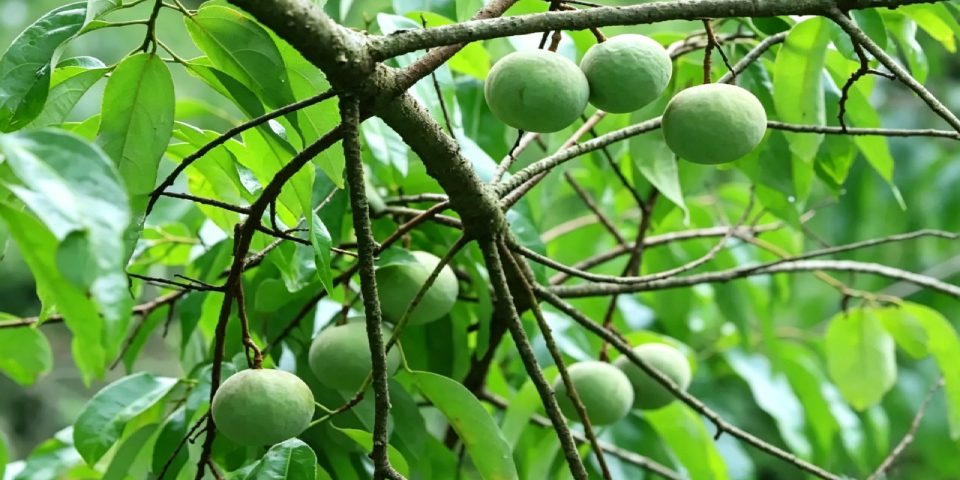
Deep in the karst mountains of southwestern China grows a rare tree found nowhere else on Earth — one whose seeds yield an oil with the highest nervonic acid content of any known plant species.
Malania oleifera seed oil is extracted from the seeds of Malania oleifera — an ancient, endemic tree species of the Olacaceae family that grows exclusively in the karst regions of southeastern Yunnan and western Guangxi. Also known locally as shantongguo or malanhou, this evergreen tree is one of China’s most treasured — and most underexplored — oilseed species.
What makes Malania oleifera extraordinary is not just its rarity, but the remarkable composition of its seed oil. With nervonic acid (C24:1) concentrations reaching up to 55.7% of total fatty acids, it surpasses every other plant source in the world for this critical brain-healthy compound. But the tree’s value extends far beyond oil: its seeds contain a novel anti-cancer protein, its leaves yield natural benzaldehyde, and its roots harbor antimicrobial compounds.
A comprehensive 2025 review by Wu Rongrong and colleagues at the Guizhou Institute of Subtropical Crops, published in China Oils and Fats (Vol. 50, No. 6), systematically surveyed the nutritional components and product development progress of Malania oleifera — providing the most complete picture to date of this botanical treasure.
01An Endemic Treasure of China’s Karst Landscape
Malania oleifera is a relict species — a living survivor from ancient forests that has persisted in the rugged limestone landscapes of southwestern China. Its distribution is extraordinarily narrow: field surveys conducted in 2023 confirmed the species across just 19 counties in Guangxi and 3 counties in Yunnan, with Guangxi alone hosting over 200,000 individual trees. By 2021, Yunnan province had established approximately 2,000 hectares (30,000 mu) of cultivated plantations.
The tree is remarkably well-adapted to karst and rocky desertification environments, making it a valuable species for ecological restoration in degraded landscapes. It thrives in warm, humid climates and serves as a dominant tree species in both karst and non-karst stony desertification zones — a rare combination of ecological resilience and economic value.
Every part of the tree has value: Seeds yield oil, nervonic acid, and protein; fruit shells and peels contain crude fat and lignans; leaves produce flavonoids and volatile oil; roots contain antibacterial compounds.
02Nutritional Composition of the Seed Kernel
The seed kernel is the primary utilization target of Malania oleifera, and its nutritional profile is nothing short of exceptional. Oil content across different growing regions ranges from 40.28% to 65.00%, with an average of 56.73% — comparable to some of the richest oilseeds in the world.
Fatty Acid Profile: A Nervonic Acid Champion
The fatty acid composition of Malania oleifera seed oil is what sets it apart from every other plant oil. Gas chromatography analyses across six representative populations reveal a composition dominated by two monounsaturated fatty acids: nervonic acid and oleic acid.
| Fatty Acid | Shorthand | Range (%) |
|---|---|---|
| Nervonic acid | C24:1 | 33.17 – 55.70 |
| Oleic acid | C18:1 | 23.81 – 30.81 |
| Erucic acid | C22:1 | 12.90 – 15.20 |
| Eicosenoic acid | C20:1 | 1.28 – 15.38 |
| Linoleic acid | C18:2 | 0.53 – 1.54 |
| Linolenic acid | C18:3 | 0.55 – 1.94 |
| Palmitic acid | C16:0 | 0.45 – 1.28 |
| Stearic acid | C18:0 | 0.20 – 1.04 |
| Behenic acid | C22:0 | 0 – 1.94 |
Nervonic acid (cis-15-tetracosenoic acid) is the defining compound of this oil. As the core structural component of myelin — the protective sheath that insulates nerve fibers — nervonic acid is essential for brain development, nerve signal conduction, and the repair of damaged neural tissue. The human body cannot efficiently synthesize it, making dietary sources critical.
Research has shown that nervonic acid content in the oil correlates positively with average temperature, annual precipitation, and longitude of the growing region, while correlating negatively with altitude. This means trees grown in warmer, lower-elevation karst valleys tend to produce the highest-quality oil.
Oleic acid, the second-most abundant fatty acid at 23.81–30.81%, is well-documented for its role in regulating blood lipids, reducing inflammation, and providing antioxidant protection. Together, nervonic acid and oleic acid account for over 70% of the total fatty acid content — making Malania oleifera seed oil one of the most monounsaturated-rich oils in the plant kingdom.
Why nervonic acid matters: Low nervonic acid levels have been linked to multiple sclerosis, adrenoleukodystrophy, and cognitive decline. Supplementation supports infant neurological development and may help repair demyelinated nerve fibers.
Protein: 17 Amino Acids and a Novel Anti-Cancer Compound
Seed kernel protein content ranges from 9.6% to 21.02%, with a rich amino acid profile comprising 17 amino acids. The protein’s amino acid ratio coefficient reaches 77.25 — indicating high nutritional value and excellent amino acid balance.
Beyond its nutritional value, Malania oleifera seed contains a unique glycoprotein known as Malanin — a 61,875 Da protein with an α+β structural fold stabilized by Ca²⁺ ions. Research has revealed that Malanin exhibits potent cytotoxicity against HeLa (cervical cancer) and HepG-2 (liver cancer) cell lines, positioning it as a potential candidate for cancer immunotoxin therapy.
However, Malanin shares structural similarities with ricin — a potent plant toxin — and carries comparable toxicity. Current research at Yunnan University’s School of Pharmaceutical Sciences is exploring site-directed mutagenesis to engineer low-toxicity Malanin variants that retain anti-tumor activity while reducing harmful side effects, paving the way for safe therapeutic applications.
Minerals, Polysaccharides, and Volatile Oil
The seed kernel is also a rich source of essential minerals. Analysis of seven metallic elements revealed potassium (12.12 mg/g), magnesium (2.259 mg/g), and calcium (0.1926 mg/g) as the most abundant — with high potassium and low sodium content qualifying it as a “high-potassium, low-sodium” food suitable for cardiovascular health dietary applications.
Additionally, the kernel contains 0.600% polysaccharides and 0.26 mL/100g volatile oil, adding further functional value to the overall nutritional package.
03Beyond the Seed: Peel, Shell, Leaves, and Roots
While the seed kernel has received the most research attention, every part of the Malania oleifera tree contains bioactive compounds worth exploring.
Fruit Shell and Peel
Solvent extraction studies have yielded 6.47% crude fat from shells and 6.60% from peels. The shell also contains 1.148% total lignans — plant polyphenols with documented antioxidant, anti-inflammatory, and phytoestrogenic activities that are increasingly studied for cardiovascular and metabolic health benefits.
Leaves: Flavonoids and Volatile Oil
Ethanol extraction of leaves yields up to 16.78% flavonoids — plant metabolites known for antioxidant, anti-inflammatory, and immune-modulating properties. Supercritical CO₂ extraction of leaf volatile oil achieves a 0.72% recovery rate, with the primary components being mandelonitrile (64.98%) and benzaldehyde (13.12%).
Roots: Natural Antimicrobial Compounds
Malania oleifera has a fleshy, shallow root system with well-developed lateral roots. Acetone extracts of the root have demonstrated antibacterial activity against Staphylococcus haemolyticus, Streptococcus agalactiae, and Bacillus cereus — three pathogenic bacteria responsible for infections in humans. While the antibacterial potency and stability vary, this finding points to potential natural preservative or pharmaceutical applications.
04Product Development: From Lab to Market
Nervonic Acid Products
Given its exceptionally high nervonic acid content, Malania oleifera seed has become a primary raw material for nervonic acid supplementation. Current commercial products include:
- Nervonic acid gummy candies and tablet candies (developed jointly by Guangnan County Malania Industry Union and Zhejiang University)
- Nervonic acid capsules (produced by Nanjing Shengnuo Biotechnology)
- Nervonic acid nerve sprays and lozenges (developed by Kunming Medical College)
As awareness of brain health nutrition grows, Malania oleifera seed oil is positioned to become a cornerstone ingredient in the functional food and nutraceutical industries — particularly for products targeting cognitive health, neurodevelopment, and age-related neurological support.
Natural Benzaldehyde: A Flavor and Fragrance Opportunity
Natural benzaldehyde is widely used as a food flavoring agent and preservative, but commercial production has traditionally relied on bitter almonds, which contain relatively low benzaldehyde concentrations. Malania oleifera offers a compelling alternative:
| Source Material | Extraction Method | Benzaldehyde Content |
|---|---|---|
| Fruit flesh | Steam distillation | 78.79% |
| Leaves | Steam distillation | 61.88% |
| Fruit peel | Steam distillation | 54.98% |
| Fruit peel | Simultaneous distillation-extraction | 61.73% |
| Purified product | Vacuum distillation (N₂ protected) | 98.00% |
Using nitrogen-protected reduced-pressure distillation, benzaldehyde can be concentrated to 98% purity at an 80.8% yield — far exceeding the efficiency of bitter almond extraction. This positions Malania oleifera as a highly competitive raw material for the natural flavor and fragrance industry.
Malanin: Cancer Therapeutic Potential
The discovery of Malanin’s selective cytotoxicity against cancer cell lines opens a third frontier for Malania oleifera product development. While still in the preclinical research phase, the protein’s mechanism of action — ribosome inactivation — is shared with several FDA-approved immunotoxin therapies. If site-directed mutagenesis can successfully reduce Malanin’s toxicity while preserving its anti-tumor activity, it could become a valuable tool in targeted cancer therapy.
05Challenges and Future Outlook
Despite its extraordinary potential, the Malania oleifera industry faces several significant challenges:
- Resource scarcity: The species is endemic to a limited karst region, and wild populations are threatened by habitat degradation
- Cultivation gaps: Artificial propagation and planting technologies remain immature, limiting scale-up potential
- Underutilized byproducts: Research on the nutritional components and product applications of peels, shells, leaves, and roots is still in its early stages
- Product diversity: Current commercial development is heavily concentrated on nervonic acid extraction, leaving the protein, benzaldehyde, and flavonoid value chains largely untapped
The path forward is clear. Investment in propagation research, sustainable cultivation systems, and comprehensive utilization — where every part of the tree is transformed into value-added products — will be essential. With its unmatched nervonic acid content, unique anti-cancer protein, and high-yield natural benzaldehyde, Malania oleifera represents one of the most promising yet underdeveloped botanical resources in the world.
As the global market for natural, science-backed health ingredients continues to expand, Malania oleifera seed oil stands ready to move from niche botanical curiosity to mainstream functional ingredient — bringing the hidden wealth of China’s karst mountains to consumers worldwide.
