

How Sea Buckthorn Oil Suppresses Gastric Cancer Cell Growth — Evidence from a Peer-Reviewed Study
June 6, 2026
Goji Seed Oil Benefits: Anti-Fatigue, Heart Health & Extraction Guide for Formulators
June 9, 2026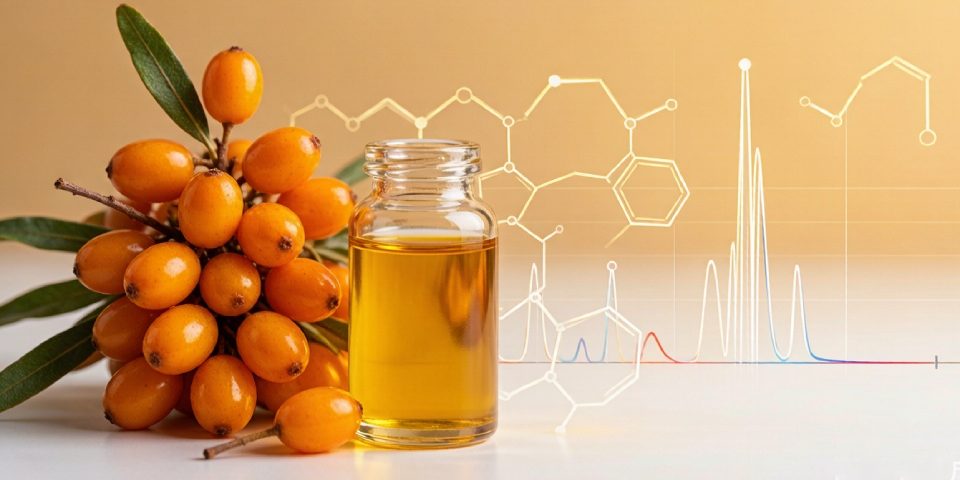
Sea buckthorn oil commands premium pricing in global markets — but its high value makes it a prime target for adulteration with cheaper vegetable oils like sunflower seed, rapeseed, and soybean oil. A landmark lipidomics study by Zhang Jiukai, Han Jianxun, and colleagues at the Chinese Academy of Inspection and Quarantine has now established a definitive UPLC-QTOF-MS method to chemically fingerprint sea buckthorn oil at the glyceride level — identifying 92 molecular markers that distinguish authentic oil from adulterants, detecting adulteration as low as 1% with R² > 0.96 model accuracy.
The Sea Buckthorn Oil Adulteration Problem: Why Purity Verification Matters
Sea buckthorn oil (Hippophae rhamnoides L.) stands apart among plant-derived functional oils. With over 206 bioactive compounds — including rare omega-7 palmitoleic acid (30–40%), omega-3 alpha-linolenic acid, beta-carotene, lycopene, vitamin E tocopherols, and phytosterols — it is one of the most compositionally complex and pharmacologically active oils in the global ingredients market. China alone cultivates over 2.15 million hectares of sea buckthorn, accounting for approximately 93% of global production. The oil has been recognized as a medicinal and edible substance since 1977 and is listed in the Pharmacopoeia of the People’s Republic of China.
This value creates a strong economic incentive for adulteration. Sea buckthorn oil typically sells at a significant premium over commodity vegetable oils. Unscrupulous suppliers may dilute it with cheaper oils (sunflower seed oil, rapeseed oil, or soybean oil) — all of which share a superficially similar yellow-to-amber appearance. Traditional fatty acid profiling via GC-MS can detect some forms of adulteration, but skilled fraudsters can blend oils to mimic fatty acid profiles, making simple GC-based tests insufficient. What’s needed is a deeper, molecular-level authentication method — one that profiles the intact glyceride molecules rather than just their fatty acid building blocks.
Why fatty acid profiling alone falls short: When an adulterator blends sea buckthorn oil with a cheap vegetable oil in proportions designed to match the fatty acid profile of authentic sea buckthorn oil, GC-MS fatty acid analysis may fail to detect the fraud. Glyceride profiling — which examines the intact DAG and TAG molecules that result from the specific enzymatic assembly of fatty acids onto the glycerol backbone in the plant — provides a far more discriminating and difficult-to-spoof molecular fingerprint.
Study Design: Building a Lipidomics Authentication Platform for Sea Buckthorn Oil
The research team, led by Zhang Jiukai at the Chinese Academy of Inspection and Quarantine (CAIQ) — China’s national reference laboratory for food authenticity testing — assembled a comprehensive sample set of 68 oil samples from commercial sources across China, all with verified authenticity documentation:
| Oil Type | Sample Count | Processing Methods / Grades | Origin Regions |
|---|---|---|---|
| Sea buckthorn oil (SJY) | 20 | SC-CO₂ extraction (whole fruit & specified origin), centrifugal separation | Shanxi, Xinjiang (Urumqi), Gansu, and other Chinese regions |
| Sunflower seed oil (KHZY) | 16 | Pressed (Grade 1), various grades | China, Ukraine, Kazakhstan, Jiangsu, Shandong, Zhejiang |
| Rapeseed oil (CZY) | 16 | Pressed (Grades 1–4), leached (Grades 1–4) | China (Sichuan, Jiangsu, Shaanxi, Heilongjiang), Shanghai |
| Soybean oil (DDY) | 16 | Leached (Grade 1), pressed (Grade 3), genetically modified & non-GM | China (Heilongjiang, Jiangsu, Shandong), USA, Brazil/Argentina |
Sample diversity was a deliberate strength: oils spanned multiple processing grades, extraction methods (supercritical CO₂, cold-press, solvent-leached), and geographic origins — ensuring the authentication model would be robust against real-world variability, not just laboratory-ideal conditions.
Each oil sample (0.1 mg) was dissolved in methanol-isopropanol (1:1, v/v) containing 5 mmol/L ammonium formate, filtered through 0.22 µm PVDF membranes, and analyzed on a Shimadzu LC-20XR UPLC system coupled to an AB Sciex TripleTOF 6600 QTOF mass spectrometer operating in positive ion mode with [M+NH₄]⁺ ammonium adduct detection. Chromatographic separation used a Phenomenex Kinetex C18 column (100 mm × 2.1 mm, 2.6 µm) with a methanol–isopropanol–water gradient. Data were acquired in full-scan TOF-MS and information-dependent acquisition (IDA) MS/MS modes, with mass accuracy maintained via automated CDS calibration every 5 samples.
Result 1: Comprehensive Glyceride Profiling — 92 Species Across 24 Fatty Acids
The UPLC-QTOF-MS lipidomics analysis identified 92 glyceride species across the four oil types — 16 diacylglycerols (DAGs) and 76 triacylglycerols (TAGs) — assembled from 24 distinct fatty acids. These spanned saturated (11 fatty acids: C8:0 through C28:0), monounsaturated (7 fatty acids: C14:1 through C26:1), and polyunsaturated (6 fatty acids: C14:2 through C20:2) categories. The equivalent carbon number (ECN) range covered 24–62 for sea buckthorn oil, reflecting its exceptionally diverse fatty acid pool.
| Parameter | Sea Buckthorn Oil | Sunflower Seed Oil | Rapeseed Oil | Soybean Oil |
|---|---|---|---|---|
| Total glycerides detected | 58 | 50 | 76 | 50 |
| DAGs | 10 | 7 | 14 | 8 |
| TAGs | 48 | 43 | 62 | 42 |
| ECN range | 24–62 | 36–56 | 38–66 | 36–58 |
| DAG double bond range | 1–6 | 2–6 | 0–6 | 2–6 |
| TAG double bond range | 0–9 | 1–9 | 2–12 | 1–9 |
| Unique saturated FAs | C22:0, C24:0 | — | C2:0, C10:0 | — |
Adapted from Zhang Jiukai et al. (2021). The presence of long-chain saturated fatty acids (C22:0 behenic acid, C24:0 lignoceric acid) in sea buckthorn oil TAGs is one molecular feature that distinguishes it from the three common adulterant oils, which lack these fatty acids in their glyceride profiles.
Key molecular distinction: Sea buckthorn oil uniquely contains glycerides incorporating C22:0 (behenic acid) and C24:0 (lignoceric acid) — very-long-chain saturated fatty acids absent from the glyceride pools of sunflower seed, rapeseed, and soybean oils. This alone provides a first-pass molecular screening criterion. Additionally, sea buckthorn oil’s ECN range extends lower (ECN 24) than any of the adulterant oils, reflecting its inclusion of medium-chain fatty acids (C8:0, C12:0) not found in the other oils.
Result 2: Hierarchical Clustering Reveals Distinct Glyceride Signatures
Hierarchical clustering analysis (HCA) heatmap visualization of the normalized glyceride abundance data revealed striking differences between oil types. While sunflower seed oil and soybean oil showed somewhat similar overall glyceride abundance patterns, sea buckthorn oil and rapeseed oil each formed well-separated clusters distinct from the other oils:
- Sunflower seed oil & soybean oil: Characterized by high levels of DAG38:2, DAG38:4, DAG40:2, DAG40:3, DAG40:4, DAG42:1, and TAG46:3, TAG46:4, TAG46:5 — reflecting their high linoleic acid (C18:2) content and similar fatty acid assembly patterns.
- Sea buckthorn oil: Distinguished by high-abundance markers including TAG40:0, TAG42:1, TAG42:3, TAG44:5, TAG44:6, TAG46:0, and TAG46:1 — glycerides that incorporate the oil’s characteristic palmitoleic acid (C16:1) and palmitic acid (C16:0) in specific positional distributions.
- Rapeseed oil: Clustered separately, reflecting its unique erucic acid (C22:1) and oleic acid (C18:1) glyceride composition.
The heatmap data confirmed that glyceride-level profiling provides substantially better discrimination between oil types than fatty acid profiling alone. Two glycerides with identical total fatty acid composition (e.g., both containing C16:0 + C18:1 + C18:2) can be assembled in different positional arrangements on the glycerol backbone — a distinction invisible to GC-MS fatty acid analysis but readily captured by intact glyceride MS/MS analysis.
Result 3: PCA and OPLS-DA Chemometric Models Achieve Near-Perfect Classification
The research team applied two complementary chemometric approaches to the 92-variable glyceride dataset:
Principal Component Analysis (PCA) — an unsupervised method — showed that the four oil types could be partially separated in the scores plot, with sea buckthorn oil forming a distinct cluster. However, some overlap existed between groups due to within-type variability (different processing grades, geographic origins, and extraction methods within each oil category). This within-group variability is precisely what makes unsupervised PCA alone insufficient for definitive authentication.
Orthogonal Partial Least Squares Discriminant Analysis (OPLS-DA) — a supervised method that filters out within-class variability unrelated to class discrimination — delivered dramatically improved separation. The OPLS-DA models for sea buckthorn oil vs. each adulterant type showed:
| OPLS-DA Model | R²X | R²Y | Q² | RMSEE | Assessment |
|---|---|---|---|---|---|
| Sea buckthorn vs. sunflower seed oil | 0.874 | 0.966 | 0.951 | 6.024 | Excellent — near-perfect class separation |
| Sea buckthorn vs. rapeseed oil | 0.813 | 0.988 | 0.982 | 5.022 | Outstanding — highest R²Y and Q² |
| Sea buckthorn vs. soybean oil | 0.854 | 0.979 | 0.970 | 5.779 | Excellent — robust discrimination |
R²X: cumulative modeled variation in X; R²Y: cumulative modeled variation in Y (class); Q²: cumulative predicted variation (cross-validated). Q² > 0.5 is considered good predictive ability; all models exceeded Q² = 0.95 — indicating outstanding predictive reliability.
Permutation testing (200 random permutations) confirmed that none of the models suffered from overfitting. The critical diagnostic — Q² regression line intercept on the Y-axis — was negative for all models (Q²(0,0) = −0.389), well below the accepted threshold of <0.05, confirming that the observed separations reflect genuine chemical differences rather than statistical artifacts.
Traditional GC-MS Fatty Acid Profiling
- Measures only hydrolyzed fatty acid methyl esters
- Cannot distinguish positional isomers
- Vulnerable to fatty-acid-matched blending fraud
- Requires sample derivatization — adds time and variability
- Limited to ~15–20 fatty acid variables
UPLC-QTOF-MS Glyceride Profiling
- Analyzes intact DAG and TAG molecules directly
- Captures positional isomerism — sn-1,2 vs. sn-1,3 DAGs
- Near-impossible to spoof via blending — 92-variable fingerprint
- No derivatization — dilute, filter, inject (<18 min run)
- 92 glyceride variables × MS/MS fragments = deep molecular resolution
Why 92 variables matter: An adulterator attempting to match sea buckthorn oil’s fatty acid profile needs to hit ~20 target values — achievable with skilled blending. Matching 92 glyceride abundances simultaneously, each with correct positional isomer ratios, requires replicating the enzymatic specificity of sea buckthorn’s native lipid biosynthesis machinery — a practically insurmountable challenge. This is why intact glyceride profiling is orders of magnitude more fraud-resistant than fatty acid profiling.
Result 4: Adulteration Detection at 1% — Building a Quantifiable Purity Model
The most commercially relevant finding was the development of quantitative adulteration prediction models. The researchers spiked authentic sea buckthorn oil with each adulterant oil at concentrations of 0%, 1%, 5%, 10%, 20%, 40%, 80%, and 100% — then built OPLS-DA regression models that predict the percentage of adulterant oil present:
| Adulterant Oil | R²X | R²Y | Q² | RMSEE | RMSEcv | Minimum Detectable Level |
|---|---|---|---|---|---|---|
| Sunflower seed oil | 0.874 | 0.966 | 0.951 | 6.02 | 8.32 | ~1% — excellent sensitivity |
| Rapeseed oil | 0.813 | 0.988 | 0.982 | 5.02 | 5.80 | ~1% — best overall model performance |
| Soybean oil | 0.854 | 0.979 | 0.970 | 5.78 | 6.09 | ~1% — robust detection |
All models achieved R²Y > 0.96 and Q² > 0.95, with root mean square errors of estimation (RMSEE) and cross-validation (RMSEcv) consistently in the range of 5–9%. The observed vs. predicted plots showed data points tightly clustered along the identity line, confirming that the models reliably quantify adulteration across the full 0–100% range. The practical detection limit of approximately 1% means even economically marginal adulteration (small-percentage dilution) can be identified.
92-Variable Molecular Fingerprint
Unlike simple fatty acid profiling, intact glyceride analysis captures the enzymatic assembly logic of each oil — providing a multi-dimensional, near-impossible-to-spoof authenticity signature that reflects the plant’s native biosynthetic machinery.
~1% Adulteration Detection
The OPLS-DA regression models reliably detect adulteration at approximately 1% across all three common adulterant oils — far exceeding the sensitivity of conventional GC-MS fatty acid methods, which typically fail below 5–10% adulteration.
Rapid & Derivatization-Free
The entire workflow from sample to result takes under 18 minutes per run, with no derivatization required. Samples are simply dissolved in methanol-isopropanol, filtered, and injected — making this method practical for routine quality control and high-throughput screening.
Statistically Validated Models
All models underwent 200-cycle permutation testing to rule out overfitting. Q² regression intercepts were negative for all models, confirming that the observed separations reflect genuine chemical differences, not statistical chance.
Real-World Sample Diversity
The training set included oils from multiple geographic origins, processing grades, and extraction methods — ensuring the model generalizes to real commercial samples rather than being tuned to laboratory-ideal conditions.
Defensible Quality Claims
For B2B ingredient suppliers and brand owners, the ability to demonstrate third-party-validated, lipidomics-level authenticity testing provides a powerful differentiator in a market where purity claims are increasingly scrutinized by regulators and customers.
Unique Glyceride Markers That Define Authentic Sea Buckthorn Oil
The study identified specific glyceride species that serve as definitive molecular markers for authentic sea buckthorn oil. These are glycerides that are present at high abundance in sea buckthorn oil but absent or very low in the three common adulterant oils:
| Marker Glyceride | Fatty Acid Composition | ECN | Present in Sea Buckthorn? | Sunflower? | Rapeseed? | Soybean? |
|---|---|---|---|---|---|---|
| DAG32:1 | C16:0 + C16:1 | 30 | ✓ High | ✗ | ✗ | ✗ |
| TAG40:0 | C8:0/C16:0/C16:0 or C12:0/C12:0/C16:0 | 40 | ✓ High | ✗ | ✗ | ✗ |
| TAG42:1 | C16:1 + C16:0 + C10:0 or variants | 40 | ✓ High | ✗ | ✗ | ✗ |
| TAG44:5 | C16:1 + C18:2 + C10:2 or C16:1/C18:3/C10:0 | 34 | ✓ Distinctive | ✗ | ✗ | ✗ |
| TAG46:0 | C16:0/C16:0/C14:0 | 46 | ✓ High | ✗ | ✗ | ✗ |
| TAG46:1 | C16:1/C16:0/C14:0 | 44 | ✓ High | ✗ | ✗ | ✗ |
| TAG58:6 | C22:0/C18:3/C18:3 combinations | 46 | ✓ Distinctive | ✗ | ✗ | ✗ |
| TAG60:6 | C24:0/C18:3/C18:3 combinations | 48 | ✓ Distinctive | ✗ | ✗ | ✗ |
These marker glycerides reflect sea buckthorn oil’s unique fatty acid pool — particularly palmitoleic acid (C16:1, omega-7), palmitic acid (C16:0), medium-chain fatty acids (C8:0, C10:0, C12:0), and long-chain saturated fatty acids (C22:0, C24:0) — assembled into glyceride structures that are essentially absent from common commodity vegetable oils.
Practical implication for B2B quality assurance: A supplier claiming 100% pure sea buckthorn oil can be verified against these specific glyceride markers. The absence of DAG32:1, TAG46:0, TAG46:1, or TAG42:1; or the unexpected presence of high-abundance DAG38:2, DAG40:3, TAG46:3, or TAG46:4 (characteristic of sunflower/soybean oil) would immediately flag a sample for further investigation — even before running the full chemometric model.
Quality Assurance Implications: Why This Matters for Sea Buckthorn Oil Buyers and Formulators
The findings of this study have direct, practical implications for every stakeholder in the sea buckthorn oil supply chain:
For Ingredient Suppliers
Third-party UPLC-QTOF-MS glyceride profiling provides defensible, publication-grade evidence of oil authenticity — a powerful differentiator in competitive B2B markets where buyers increasingly demand batch-level purity documentation beyond basic fatty acid CoAs.
For QA/QC Laboratories
The 18-minute, derivatization-free workflow is practical for routine quality control. The identified marker glycerides (DAG32:1, TAG46:0, TAG46:1, etc.) provide rapid screening targets before full chemometric analysis is needed.
For Nutraceutical Brands
Brands building products around sea buckthorn oil’s documented health benefits (omega-7, carotenoids, phytosterols) need assurance that their raw material is authentic. This lipidomics method provides the most rigorous available authenticity verification for label claim substantiation.
For Regulatory & Compliance
As sea buckthorn oil gains GRAS and novel food approvals in additional jurisdictions, the availability of a validated, peer-reviewed authentication method becomes essential for demonstrating identity, purity, and freedom from economically motivated adulteration.
For Cosmeceutical Formulators
Skin-care and beauty-from-within products built around sea buckthorn oil’s omega-7 and carotenoid content depend on authentic raw material to deliver clinical results. Adulterated oil compromises efficacy and brand reputation.
For Bulk Procurement
Large-volume B2B buyers can incorporate glyceride profiling into supplier qualification protocols — establishing objective, data-driven acceptance criteria that protect against supply-chain fraud and ensure batch-to-batch consistency.
How to Verify Your Sea Buckthorn Oil: A Practical Authentication Checklist
Based on the lipidomics evidence from this study, here is a practical framework for sea buckthorn oil authenticity verification at the B2B level:
- Start with fatty acid GC profiling — verify the expected omega-7 palmitoleic acid (C16:1) content, omega-3 ALA (C18:3), and check for anomalous fatty acids (e.g., high C18:2 linoleic acid may indicate sunflower/soybean adulteration). This is a necessary first step but insufficient alone.
- Request glyceride profiling by UPLC-QTOF-MS or equivalent LC-HRMS — specifically screen for the sea buckthorn-specific markers: DAG32:1, TAG40:0, TAG42:1, TAG46:0, TAG46:1. Their absence or unusually low abundance warrants further investigation.
- Screen for adulterant-specific glycerides — the presence of high-abundance DAG38:2, DAG40:3, TAG46:3, or TAG46:4 signals potential sunflower or soybean oil adulteration. TAG species with C22:1 (erucic acid) may indicate rapeseed oil contamination.
- Use OPLS-DA or equivalent chemometric classification — for definitive authentication, compare the sample’s full 92-variable glyceride profile against the reference database using the models described in this study. Q² > 0.95 provides high-confidence classification.
- Request batch-level CoA including glyceride markers — progressive suppliers are beginning to include key glyceride marker data alongside conventional fatty acid profiles, carotenoid content, and oxidative stability parameters in their certificates of analysis.
Red flags in sea buckthorn oil procurement: (1) unusually low price relative to market average — high-quality sea buckthorn berry oil commands a premium due to limited raw material and extraction costs; (2) GC fatty acid profile that appears “too clean” — natural sea buckthorn oil has characteristic minor fatty acids (C8:0, C10:0, C12:0, C22:0, C24:0) that are absent from commodity oils; (3) reluctance to provide batch-specific glyceride or LC-MS data beyond basic fatty acid CoA; (4) oil that is pale yellow rather than the characteristic deep orange-red of authentic sea buckthorn berry pulp oil (seed oil is lighter but should not be sold as berry oil).
Frequently Asked Questions
Why is sea buckthorn oil particularly vulnerable to adulteration?
Sea buckthorn oil is one of the most expensive plant-derived functional oils on the global market — driven by limited raw material availability (the berries are small, thorny, and labor-intensive to harvest), relatively low oil yield (~1.4–13.7% for seeds, ~10% for berry pulp), and high demand from nutraceutical, cosmeceutical, and functional food sectors. The global supply-demand gap exceeds 1,200 tons annually. This price premium creates a strong economic incentive to dilute sea buckthorn oil with cheaper commodity vegetable oils — particularly sunflower seed, rapeseed, and soybean oil, which share a similar amber appearance. Traditional fatty acid testing can be defeated by skilled blending; glyceride-level lipidomics, as demonstrated in this study, provides a far more robust authentication solution.
What is the difference between fatty acid profiling and glyceride profiling?
Fatty acid profiling (typically by GC-MS of fatty acid methyl esters, or FAMEs) measures the individual fatty acids released after chemically hydrolyzing all glyceride molecules. This tells you what fatty acids are present but loses all information about how they were assembled into intact DAG and TAG molecules — including which fatty acids were esterified at which positions on the glycerol backbone (sn-1, sn-2, sn-3). Glyceride profiling (by LC-MS or UPLC-QTOF-MS) analyzes the intact lipid molecules directly, preserving this positional and compositional information. Because each plant species has unique acyltransferase enzymes that assemble fatty acids onto glycerol in specific patterns, the glyceride fingerprint is a far more discriminating authenticity marker than the fatty acid profile alone. In this study, 92 glyceride variables provided dramatically better oil-type discrimination than the 24 underlying fatty acids could achieve individually.
At what level can this method detect adulteration?
The OPLS-DA regression models built in this study can detect adulteration of sea buckthorn oil with sunflower seed, rapeseed, or soybean oil at approximately 1% — meaning if just 1 part in 100 of a sea buckthorn oil sample is replaced with a cheaper oil, the model can detect the anomaly. This sensitivity far exceeds conventional GC-MS fatty acid profiling, which typically requires 5–10% adulteration before deviations from the expected fatty acid profile become statistically detectable. The practical limit of ~1% means even economically marginal adulteration is identifiable, protecting buyers against both blatant and subtle fraud.
Can this method distinguish sea buckthorn berry oil from sea buckthorn seed oil?
While this specific study focused on distinguishing sea buckthorn oil from other plant species’ oils and did not explicitly build models to separate berry pulp oil from seed oil, the underlying methodology is well-suited for this purpose. Berry pulp oil and seed oil have substantially different fatty acid compositions (berry oil: rich in palmitoleic acid C16:1; seed oil: rich in linoleic acid C18:2 and alpha-linolenic acid C18:3), which would generate distinct glyceride profiles. The same UPLC-QTOF-MS lipidomics workflow could be applied to build a berry-vs-seed classification model — an important application since berry oil commands a higher price than seed oil. For B2B buyers, always verify whether you are purchasing berry pulp oil, seed oil, or a blend, and request the corresponding fatty acid and glyceride documentation.
What should I look for in a sea buckthorn oil Certificate of Analysis (CoA)?
Beyond the standard parameters (fatty acid profile by GC, peroxide value, acid value, carotenoid content, tocopherol content, heavy metals, microbiology), a comprehensive CoA for premium sea buckthorn oil should ideally include: (1) Omega-7 palmitoleic acid content — typically 30–40% for berry pulp oil; (2) Total carotenoids + beta-carotene — responsible for the oil’s distinctive color and antioxidant activity; (3) Oxidative stability markers — PV, AnV, TOTOX; low values indicate proper handling and storage; (4) Extraction method specification — SC-CO₂ extraction preserves thermolabile bioactives better than solvent extraction; (5) Origin traceability — geographic origin and harvest date; (6) increasingly, glyceride profiling data from LC-MS or UPLC-QTOF-MS — as demonstrated in this study, this provides the highest level of authenticity assurance available today.
Is this lipidomics method practical for routine quality control?
Yes. While UPLC-QTOF-MS instrumentation represents a significant capital investment, the per-sample workflow is remarkably straightforward: weigh 0.1 mg oil → dissolve in methanol-isopropanol → filter → inject → 18-minute run → data processing. No derivatization, no lengthy sample preparation, and the method is amenable to high-throughput automation. For organizations that process significant volumes of sea buckthorn oil, the cost of even a single batch of adulterated raw material can far exceed the cost of instrument time. Many contract analytical laboratories now offer glyceride profiling as a service, making the technology accessible to buyers who do not maintain in-house LC-HRMS capability. The peer-reviewed method and reference data from this study provide a validated protocol that any competent analytical laboratory can implement.
Source Authenticated Sea Buckthorn Oil — Verified by Lipidomics
TongyuBio supplies bulk sea buckthorn oil — both berry pulp oil and seed oil — with comprehensive CoA documentation including GC fatty acid profiles, carotenoid assays, tocopherol analysis, heavy metals, and microbiological specifications. SC-CO₂ extraction preserves thermolabile bioactives. Glyceride profiling data available on request for buyers who demand the highest standard of authenticity verification. Worldwide B2B shipping with flexible MOQ.
Zhang Jiukai, Han Jianxun, et al. Comparative Analysis of Glyceride Composition of Sea Buckthorn Oil and Its Adulterated Oils Based on Lipidomics (基于脂质组学的沙棘油及其掺假油的甘油酯组成比较分析). Journal of Chinese Institute of Food Science and Technology (中国食品学报). 2021, 21(11): 144–158. DOI: 10.16429/j.1009-7848.2021.11.017. ISSN 1009-7848.
Authors’ affiliations: (1) Chinese Academy of Inspection and Quarantine (CAIQ), Beijing 100176; (2) College of Food Science and Technology, Nanjing Agricultural University, Nanjing 210095; (3) Institute of Agricultural Quality Standards and Testing Technology, Chinese Academy of Agricultural Sciences (CAAS), Beijing 100081. Funded by: National Key R&D Program of China — 13th Five-Year Plan (No. 2018YFC1603504).
Key References Cited in the Study
Yang BR, et al. Phytochemistry and pharmacological activities of sea buckthorn — a review. Food Research International. 2016.
Han X, et al. The emerging field of lipidomics. Journal of Lipid Research. 2003.
Wei F, et al. Rapid profiling and quantification of triacylglycerols in 18 edible oils by UPLC-QTOF-MS. Food Chemistry. 2019.
Li X, et al. Application of lipidomics in food authentication: a review. Trends in Food Science & Technology. 2020.
