
Eucommia Seed Oil: 61% Alpha-Linolenic Acid & #1 Antioxidant Among 11 Vegetable Oils
April 25, 2026
The Most Nervonic-Acid-Rich Plant in the World: An Introduction to Malania oleifera
April 29, 2026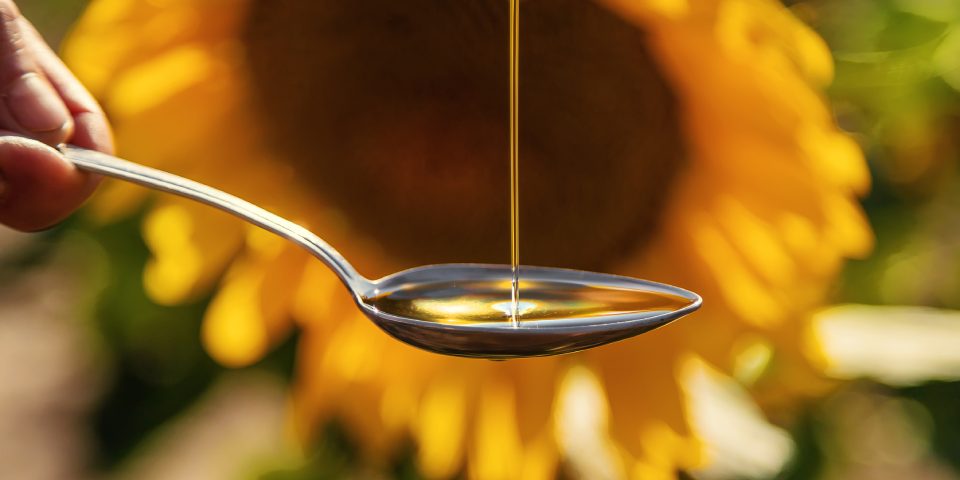
Background: Why This Comparison Matters
Camellia oil (Camellia oleifera seed oil, also known as tea camellia oil) has long been celebrated in China as a premium edible oil — prized for its high oleic acid content, natural tocopherols, squalene, and cholesterol-lowering phytosterols. It is frequently positioned as the “Eastern olive oil.”
Yet a functionally similar oil has been quietly gaining ground: high oleic sunflower oil. Developed through selective crop breeding to dramatically raise oleic acid content, it rivals camellia oil in its fatty acid profile — but has received far less scientific attention in the Chinese market, and national standards have yet to be formally established.
A 2021 study published in China Oils and Fats journal set out to fill that gap, conducting the first comprehensive head-to-head comparison using cold-pressed versions of both oils.
1. Fatty Acid Composition: Close, But With Key Differences
Fatty acid profiles were analyzed per Chinese national standard GB 5009.168—2016. Both oils are monounsaturated fatty acid (MUFA)-dominant, with oleic acid (C18:1) as the primary component, and both fall within the GB/T 11765—2018 camellia oil standard range.
| Fatty Acid | High Oleic Sunflower Oil | Camellia Oil | Verdict |
|---|---|---|---|
| Oleic acid (C18:1) | Significantly higher ↑ | Lower | Sunflower wins |
| Palmitic acid (C16:0) | Significantly lower ↓ | Higher | Sunflower wins |
| α-Linolenic acid (C18:3) | Lower | Higher | — |
| Stearic acid (C18:0) | Higher | Lower | — |
| Myristic / Palmitoleic acid | No significant difference | — | |
2. Nutrient Content: High Oleic Sunflower Oil Leads Across the Board
This is where the most striking differences emerge. High oleic sunflower oil significantly outperforms camellia oil on every major bioactive nutrient measured:
| Nutrient | High Oleic Sunflower Oil (mg/kg) | Camellia Oil (mg/kg) | Difference |
|---|---|---|---|
| α-Tocopherol (Vitamin E) | 380.20 | 164.20 | × 2.3 |
| (β+γ)-Tocopherol | 23.50 | 7.67 | × 3.1 |
| δ-Tocopherol | 0.84 | 0.00 | Only in sunflower oil |
| Squalene | 64.50 | 21.47 | × 3.0 |
| β-Sitosterol | 1,064.00 | 200.30 | × 5.3 |
| Campesterol | 147.90 | 0.00 | Only in sunflower oil |
| Stigmasterol | 140.30 | 168.70 | Camellia slightly higher |
Tocopherols are the primary fat-soluble natural antioxidants (Vitamin E complex) — they protect both the oil from oxidative degradation and support human cellular health. Squalene is a triterpene with emollient, immunomodulatory, and skin-protective properties, widely used in premium cosmetics and nutraceuticals. Phytosterols — particularly β-sitosterol — are clinically recognized for reducing LDL cholesterol absorption and are staple ingredients in functional food formulations.
3. Oxidative Stability: High Oleic Sunflower Oil’s Defining Edge
The research team used a Rancimat instrument at 120°C to measure Oxidative Stability Index (OSI), and applied the Arrhenius equation to model oxidation kinetics and predict real-world shelf life at typical storage temperatures.
Oxidative Induction Time (at 120°C)
High oleic sunflower oil’s oxidative induction time was approximately 2× longer than camellia oil, with a statistically significant difference (P ≤ 0.05). Under identical thermal stress, it resists oxidative breakdown for twice as long.
Predicted Shelf Life (Sealed, Dark Storage)
| Storage Temperature | High Oleic Sunflower Oil | Camellia Oil | Ratio |
|---|---|---|---|
| 25°C (room temperature) | 293 days | 172 days | × 1.7 |
| 15°C (cool storage) | 691 days (~23 months) | 141 days | × 4.9 |
It’s also worth noting that the starting peroxide value of the cold-pressed high oleic sunflower oil used in this study was 0.399 mmol/kg — significantly lower than the camellia oil’s initial value of 2.992 mmol/kg. This means high oleic sunflower oil enters storage in a substantially fresher oxidative state, further extending its practical shelf life advantage.
4. What This Means for Ingredient Buyers
Why High Oleic Sunflower Oil Deserves a Place in Your Formulation
- Higher bioactive nutrient density — Tocopherols, squalene, and phytosterols at 2–5× the levels of camellia oil
- Superior oxidative stability — ~2× longer OSI; ideal for shelf-stable, clean-label products
- Outstanding cold-chain performance — 691-day shelf life at 15°C supports premium, long-life product lines
- Equivalent fatty acid positioning — MUFA-dominant like camellia oil; easy for consumers to understand
- Supply chain reliability — Stable, scalable feedstock with more predictable pricing than camellia oil
The evidence from this peer-reviewed study is clear: high oleic sunflower oil is not simply a budget alternative to camellia oil — in measurable, data-backed terms, it is a nutritionally superior ingredient with exceptional oxidative stability. Its higher tocopherol, squalene, and phytosterol content, combined with a 2× longer oxidative induction time and up to 4.9× longer shelf life, make it a compelling choice for functional food manufacturers, nutraceutical brands, and cosmetic formulators.
As national standards for high oleic sunflower oil continue to develop in China, early-adopting brands have an opportunity to differentiate on both quality and science.
Interested in sourcing food-grade high oleic sunflower oil with consistent batch specs? Contact Tongyu Biotech for bulk pricing, technical data sheets, and COAs.
Reference
[1] Cheng HG, Guo CJ, Dong QX. Comparison of fatty acid composition, nutrients and oxidative stability between high oleic acid sunflower seed oil and oil-tea camellia seed oil[J]. China Oils and Fats, 2021, 46(12): 123-126. DOI: 10.19902/j.cnki.zgyz.1003-7969.210057
