
Organic Germanium (Ge-132) Enhances Cyclophosphamide Antitumor Effect in Hepatocellular Carcinoma
May 3, 2026
Sea Buckthorn Oil Fatty Acid Profile: Palmitoleic Acid (ω-7) & ALA Content Guide
May 5, 2026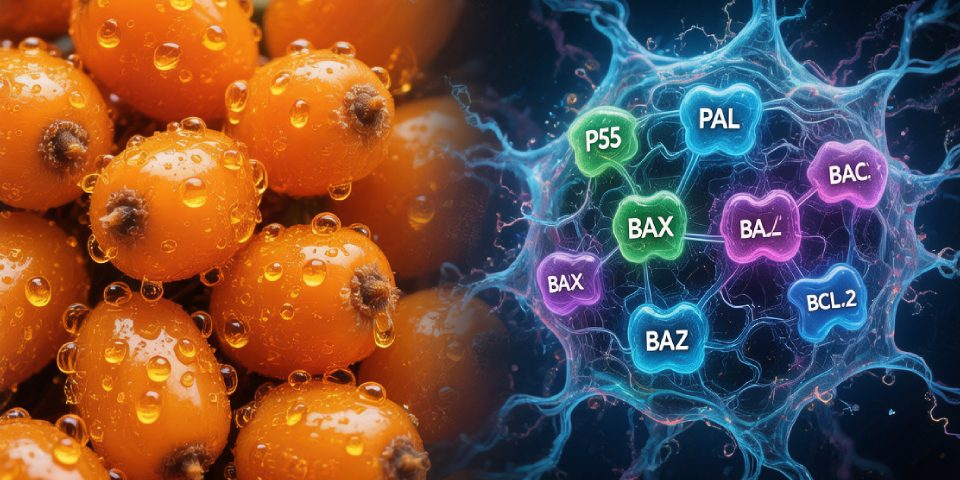
Sea Buckthorn Seed Oil Suppresses Gastric Cancer Cell Growth via the P53 Apoptosis Pathway
Peer-reviewed cell study: Sea buckthorn seed oil reduced gastric cancer BGC-823 cell viability by up to 74%, upregulated tumor suppressor P53 and pro-apoptotic BAX, and downregulated anti-apoptotic BCL-2 — all in a dose-dependent manner (P<0.05).
(20 μg/mL vs control)
(20 μg/mL vs control)
(20 μg/mL vs control)
(≥5 μg/mL, P<0.05)
Gastric Cancer: A Problem That Demands Better Tools
Gastric cancer remains one of the most common and deadly malignancies of the digestive system worldwide. Despite advances in surgery and chemotherapy, the prognosis for advanced gastric cancer remains poor — and the search for effective, low-toxicity anti-tumor agents continues.
At the center of that search is the P53 tumor suppressor gene — the most extensively studied cancer-related gene in human biology. Found mutated in over 50% of all human tumors, P53 plays a critical role in regulating cell cycle arrest, programmed cell death (apoptosis), and the suppression of new blood vessel growth that tumors depend on. In gastric cancer specifically, P53 expression has been shown to correlate directly with the degree of malignancy and patient prognosis.
Researchers at Jingbian County People's Hospital set out to investigate whether a natural plant oil — sea buckthorn seed oil — could activate this pathway and suppress gastric cancer cell growth. The results, published in the Journal of Changzhi Medical College (2021), are compelling.
Why Sea Buckthorn Seed Oil?
Sea buckthorn (Hippophae rhamnoides) seed oil is a premium botanical extract pressed from the seeds of the sea buckthorn berry. Unlike the fruit pulp oil, the seed oil is especially rich in:
- Unsaturated fatty acids — particularly alpha-linolenic acid (omega-3) and linoleic acid (omega-6)
- Vitamin E and beta-carotene — potent antioxidants
- Selenium and trace minerals — essential co-factors in immune and cellular defense
- Phytosterols and bioactive compounds — with demonstrated immunomodulatory properties
Prior research had already suggested that sea buckthorn extracts could induce apoptosis in liver cancer cells (2004), and that total sea buckthorn flavonoids inhibited colon cancer cell proliferation. The current study was the first to systematically investigate sea buckthorn seed oil in a human gastric cancer model and to pinpoint its molecular mechanism.
The Study Design
The study used the BGC-823 human gastric cancer cell line — a well-established model for evaluating anti-tumor compounds in gastric cancer research.
Because sea buckthorn oil is not water-soluble, the researchers first validated the safe dosage of the cosolvent DMSO (dimethyl sulfoxide) used to dissolve the oil. CCK-8 assays confirmed that DMSO concentrations at or below 0.1% had no effect on BGC-823 cell viability — establishing a clean experimental baseline.
Sea buckthorn oil was then applied to BGC-823 cells at concentrations of 0, 1, 2, 5, 10, and 20 μg/mL for 24 hours. Two primary measurements were taken:
- CCK-8 assay — to measure changes in cell proliferation/viability
- Western blot — to quantify protein expression of P53, BCL-2, and BAX
Results: The Data in Full
Cell Proliferation Inhibition: Dose-Dependent and Statistically Significant
All four active concentrations (2, 5, 10, and 20 μg/mL) significantly suppressed BGC-823 cell growth compared to the control (P<0.05). The effect was clearly dose-dependent:
| Sea Buckthorn Oil Concentration | BGC-823 Cell Viability (mean ± SD) | vs. Control | P value |
|---|---|---|---|
| 0 (control) | 1.07 ± 0.04 | — | — |
| 2 μg/mL | 0.72 ± 0.10 | −33% | 0.017* |
| 5 μg/mL | 0.56 ± 0.06 | −48% | 0.001* |
| 10 μg/mL | 0.45 ± 0.09 | −58% | 0.001* |
| 20 μg/mL | 0.28 ± 0.06 | −74% | 0.001* |
* Statistically significant vs. control (P<0.05)
Western Blot: Sea Buckthorn Oil Triggers the P53 Apoptosis Switch
The molecular mechanism became clear in the Western blot analysis. Sea buckthorn oil triggered a coordinated shift in three key apoptosis-regulating proteins:
| Concentration | P53 (mean ± SD) | BCL-2 (mean ± SD) | BAX (mean ± SD) |
|---|---|---|---|
| 0 (control) | 0.33 ± 0.09 | 0.80 ± 0.08 | 0.25 ± 0.05 |
| 2 μg/mL | 0.37 (ns) | 0.61* ↓ | 0.44* ↑ |
| 5 μg/mL | 0.54* ↑ | 0.55* ↓ | 0.63* ↑ |
| 10 μg/mL | 0.59* ↑ | 0.48* ↓ | 0.77* ↑ |
| 20 μg/mL | 0.70* ↑ (+112%) | 0.33* ↓ (−59%) | 1.03* ↑ (+312%) |
* P<0.05 vs. control; ns = not statistically significant
Three findings stand out from this data:
- P53 activation began at 5 μg/mL, with expression rising steadily through 20 μg/mL — confirming dose-dependent tumor suppressor activation.
- BCL-2 suppression began as early as 2 μg/mL, before P53 was significantly activated — suggesting sea buckthorn oil may engage multiple pathways simultaneously.
- BAX increased dramatically at high doses: at 20 μg/mL, BAX expression reached 1.03 ± 0.13, a 312% increase over the control value of 0.25 — the largest change observed in the study.
Understanding the Mechanism: The P53–BAX–BCL-2 Axis
To appreciate why these results matter, it helps to understand the molecular circuit sea buckthorn oil appears to engage.
In healthy cells, P53 functions as a guardian: when cellular stress or DNA damage is detected, it activates transcription of genes that initiate apoptosis. One of its key targets is BAX — a protein that punches holes in the mitochondrial membrane, triggering the caspase cascade that executes cell death. Meanwhile, BCL-2 acts as the counterforce, plugging those holes and keeping cancer cells alive.
Cancer cells frequently survive by suppressing P53 (through mutation or other mechanisms) and overexpressing BCL-2. Sea buckthorn oil appears to reverse this balance: it restores P53 activity at the transcriptional level, upregulates BAX, and simultaneously suppresses BCL-2. The net result is that gastric cancer cells are pushed past the apoptosis threshold — they age prematurely and die.
The authors note that this mechanism aligns with findings from studies on other natural compounds: TCM formulations inhibiting SGC-7901 gastric cancer cells via P53/BCL-2 modulation, and baicalin (from Scutellaria) inhibiting MGC-803 gastric cancer cells through the same pathway. Sea buckthorn seed oil appears to engage this conserved mechanism from a completely different phytochemical direction.
Key Takeaways
| Finding | What It Means |
|---|---|
| Cell viability −74% at 20 μg/mL | Potent anti-proliferative effect at relatively low concentrations; dose-dependent across all tested levels |
| P53 ↑ / BCL-2 ↓ / BAX ↑ | Clear molecular mechanism — sea buckthorn oil activates the P53 tumor suppressor pathway to induce apoptosis |
| BCL-2 suppression at 2 μg/mL | Anti-apoptotic resistance begins to be reversed at the lowest effective concentration — even before P53 is significantly activated |
| Natural botanical origin | Sea buckthorn seed oil is food-grade and widely used in nutraceuticals; its safety profile makes it a practical candidate for adjuvant formulation research |
Frequently Asked Questions
Why Choose TongyuBio for Sea Buckthorn Seed Oil?
Full documentation
Flexible order sizes
botanical extracts
pharma grade supply
References
| # | Citation |
|---|---|
| 1 | Bai LG, Jing L, Cai X, et al. Inhibition Effects of Seabuckthorn Oil on the Proliferation of Human Gastric Cancer Cells and Its Mechanism. Journal of Changzhi Medical College. 2021;35(4):245-248. |
| 2 | Zhang P. Study on apoptosis of human tumor cells induced by flavonoids from sea buckthorn seed residue and its mechanism [D]. East China Normal University, 2004. |
| 3 | Fan L. Experimental study on inhibition of HCT-116 colon cancer cell proliferation and invasion by sea buckthorn, nutmeg, and their combination [D]. Xinjiang Medical University, 2015. |
| 4 | Qu TT, Cai YW. Effect of TCM Huoxue Xingqi formula serum on P53 and BCL-2 gene expression in human gastric cancer SGC-7901 cells. Chinese Archives of Traditional Chinese Medicine. 2011;(3):629-630. |
| 5 | Lin FD, Huang B. Effects of baicalin on apoptosis and related gene expression in human gastric cancer MGC-803 cells. Chinese Journal of Clinical Pharmacology. 2019;35(12):1278-1280. |
| 6 | Lu YY. Medicinal sea buckthorn oil. China Journal of Chinese Materia Medica. 1989;14(1):57-59. |
Interested in Sea Buckthorn Seed Oil for Your Formulation?
TongyuBio supplies high-purity sea buckthorn seed oil with full COA documentation. Request a quote or free sample today.
