
The Most Nervonic-Acid-Rich Plant in the World: An Introduction to Malania oleifera
April 29, 2026
Organic Germanium (Ge-132) Enhances Cyclophosphamide Antitumor Effect in Hepatocellular Carcinoma
May 3, 2026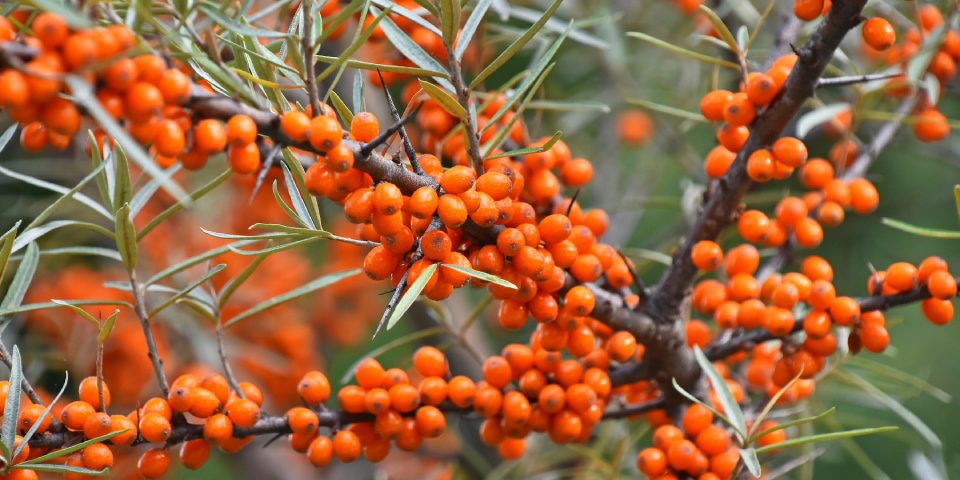
Not all sea buckthorn oils are the same. Seed oil, fruit (pulp) oil, and whole fruit oil each carry a distinct fatty acid fingerprint and antioxidant signature — understanding the difference is essential for formulators, supplement makers, and ingredient buyers selecting the right raw material for their application.
unsaturated fatty acids
(mg/mL) — best performer
unsaturated fatty acids
used in this study
DPPH · ABTS⁺ · Reducing power · TAC
What Is Sea Buckthorn Oil?
Hippophae rhamnoides L. (sea buckthorn) is a thorny shrub native to temperate regions of Eurasia, now cultivated across China, Russia, and northern Europe for its nutrient-dense orange berries. The plant yields two commercially distinct oil types depending on the part processed:
Cold-pressed or extracted from the small inner seeds. Typically pale yellow in colour. Characterised by a high omega-3 (linolenic acid) content and a relatively neutral fatty acid profile compared to pulp oil.
Extracted from the fleshy pulp/mesocarp. Deep orange-red due to high carotenoid content. Higher in palmitoleic acid and linoleic acid. Prized in cosmetics for its intense colour and skin-active fatty acid profile.
Extracted from the entire fruit (pulp + seed together). Bioactive profile represents a blend of both fractions, providing a balanced omega-3/omega-6 ratio and combining the functional benefits of both oil types in a single ingredient.
1. Physicochemical Properties
Zheng et al. (2018) determined the physicochemical constants of all three oil types according to Chinese national standards (GB). Key parameters are compared below:
| Parameter | Seed Oil | Fruit Oil | Whole Fruit Oil |
|---|---|---|---|
| Appearance | Pale yellow | Deep orange-red | Orange-yellow |
| Odour | Mild, characteristic | Strong, fruity | Moderate, fruity |
| Total Phenol Content | Measured by UV-Vis | Higher in pulp | Intermediate |
| Unsaturated Fatty Acids (total) | ~64.52% | ~58.02% | ~60.46% |
2. Fatty Acid Composition (GC Analysis)
Gas chromatography identified five major fatty acids common to all three oil types. The relative proportions, however, differ significantly — particularly in the key omega-3/omega-6 ratio:
| Fatty Acid | Type | Seed Oil | Fruit Oil | Whole Fruit Oil |
|---|---|---|---|---|
| Palmitic Acid (C16:0) | Saturated | Present | Present (higher) | Present |
| Stearic Acid (C18:0) | Saturated | Present | Present | Present |
| Oleic Acid (C18:1) ω-9 | Mono-unsaturated | Present | Present | Present |
| Linoleic Acid (C18:2) ω-6 | Poly-unsaturated | Present | ★ Highest | Intermediate |
| Linolenic Acid (C18:3) ω-3 | Poly-unsaturated | ★ Highest | Present | Intermediate |
The primary source of variation across the three oil types is the linoleic acid (ω-6) vs. linolenic acid (ω-3) ratio. Sea buckthorn fruit oil leads in linoleic acid — relevant for skin barrier function and inflammatory modulation. Sea buckthorn seed oil leads in linolenic acid — relevant for omega-3 supplementation and anti-inflammatory applications. Whole fruit oil offers a balanced mid-point between the two.
3. Antioxidant Activity: Four-Assay Comparison
The study applied four independent in vitro antioxidant assays to provide a comprehensive picture of oxidative-protective capacity. Results revealed a nuanced profile — no single oil type dominates across all assays:
Measures hydrogen-donation capacity to neutralise stable DPPH radicals. No statistically significant difference was found among the three oil types — all three demonstrated comparable DPPH scavenging activity across the tested concentration range.
At low concentrations (0–5 mg/mL), seed oil scavenging rate slightly exceeded the others; above this range, fruit oil progressively surpassed seed and whole fruit oil. The final EC₅₀ values clearly rank fruit oil as the most potent ABTS⁺ scavenger:
Whole fruit oil EC₅₀: 15.14 mg/mL
Seed oil EC₅₀: 18.55 mg/mL
Measured by the conversion of Fe³⁺/ferricyanide to the ferrous form (absorbance at 700 nm). Higher absorbance indicates stronger electron-donating capacity. Seed oil showed the greatest reducing power, followed by whole fruit oil; fruit oil performed lowest. All three remained significantly below the positive control (Vc, ascorbic acid).
Phosphomolybdenum-based TAC assay measures both hydrophilic and lipophilic antioxidant activity. Consistent with the DPPH results, no significant difference was found among the three oil types for total antioxidant capacity, suggesting broadly equivalent overall protection against lipid peroxidation.
For broad-spectrum antioxidant formulations where overall free-radical protection matters, all three oil types perform equivalently. If the target application requires specifically strong ABTS⁺ scavenging (e.g., cosmetic anti-ageing, oxidative-stress nutraceuticals), sea buckthorn fruit oil is the preferred choice. For applications where electron-donating (reducing) capacity is prioritised, seed oil ranks highest.
4. Side-by-Side Summary
| Parameter | Seed Oil | Fruit Oil | Whole Fruit Oil |
|---|---|---|---|
| Unsaturated Fatty Acids | ★ 64.52% | 58.02% | 60.46% |
| Dominant Omega | ω-3 (Linolenic) | ω-6 (Linoleic) | Balanced |
| DPPH Scavenging | No sig. difference | No sig. difference | No sig. difference |
| ABTS⁺ EC₅₀ (mg/mL) | 18.55 | ★ 10.90 (best) | 15.14 |
| Reducing Power | ★ Highest | Lowest | Middle |
| Total Antioxidant Capacity | No sig. difference | No sig. difference | No sig. difference |
5. Application Guidance for Formulators
Given the distinct fatty acid and antioxidant profiles, each sea buckthorn oil type has a preferred application niche:
- Omega-3 enriched nutraceutical capsules
- Anti-inflammatory dietary supplements
- Cardiovascular health formulations
- Products emphasising reducing antioxidant capacity
- Pale-coloured cosmetic serums (lighter pigment)
- Premium skin care & cosmetic applications
- ABTS⁺ antioxidant-targeted formulations
- Wound healing & skin barrier support products
- High-carotenoid functional foods
- Linoleic acid–focused topical treatments
- Broad-spectrum omega supplement blends
- General wellness & daily antioxidant products
- Cost-efficient formulations seeking balanced profile
- Applications where omega-3/omega-6 balance is key
Frequently Asked Questions
Why Source Sea Buckthorn Oil from TongyuBio?
References
| # | Citation | Journal / Source |
|---|---|---|
| 1 | Zheng Man-rong, Lü Xiao-ling, Wang Jian-xin et al. (2018). Main Components and Antioxidant Activity of Three Kinds of Seabuckthorn Oil (Hippophae Rhamnoides L.) | Food Research and Development, 39(8): 24–29 |
| 2 | Bo Hai-bo & Qin Rong (2008). Comparative study on fatty acid composition of sea buckthorn fruit oil and seed oil. | Food Science, 29(5): 378–381 |
| 3 | Ting H.C., Hsu Y.W., Tsai C.F. et al. (2011). The in vitro and in vivo antioxidant properties of sea buckthorn (Hippophae rhamnoides L.) seed oil. | Food Chemistry, 125(2): 652–659 |
| 4 | Zhang Ze-sheng, Feng Fan, Hu Fang et al. (2015). Enrichment of palmitoleic acid in sea buckthorn fruit oil by molecular distillation. | Grain and Oil, (3): 39–41 |
Ready to Source Sea Buckthorn Oil?
Seed oil, fruit oil, or whole fruit oil — all with GC-verified fatty acid profiles, full COA documentation, and competitive bulk pricing. Request samples or technical data today.
